








Political Polarization
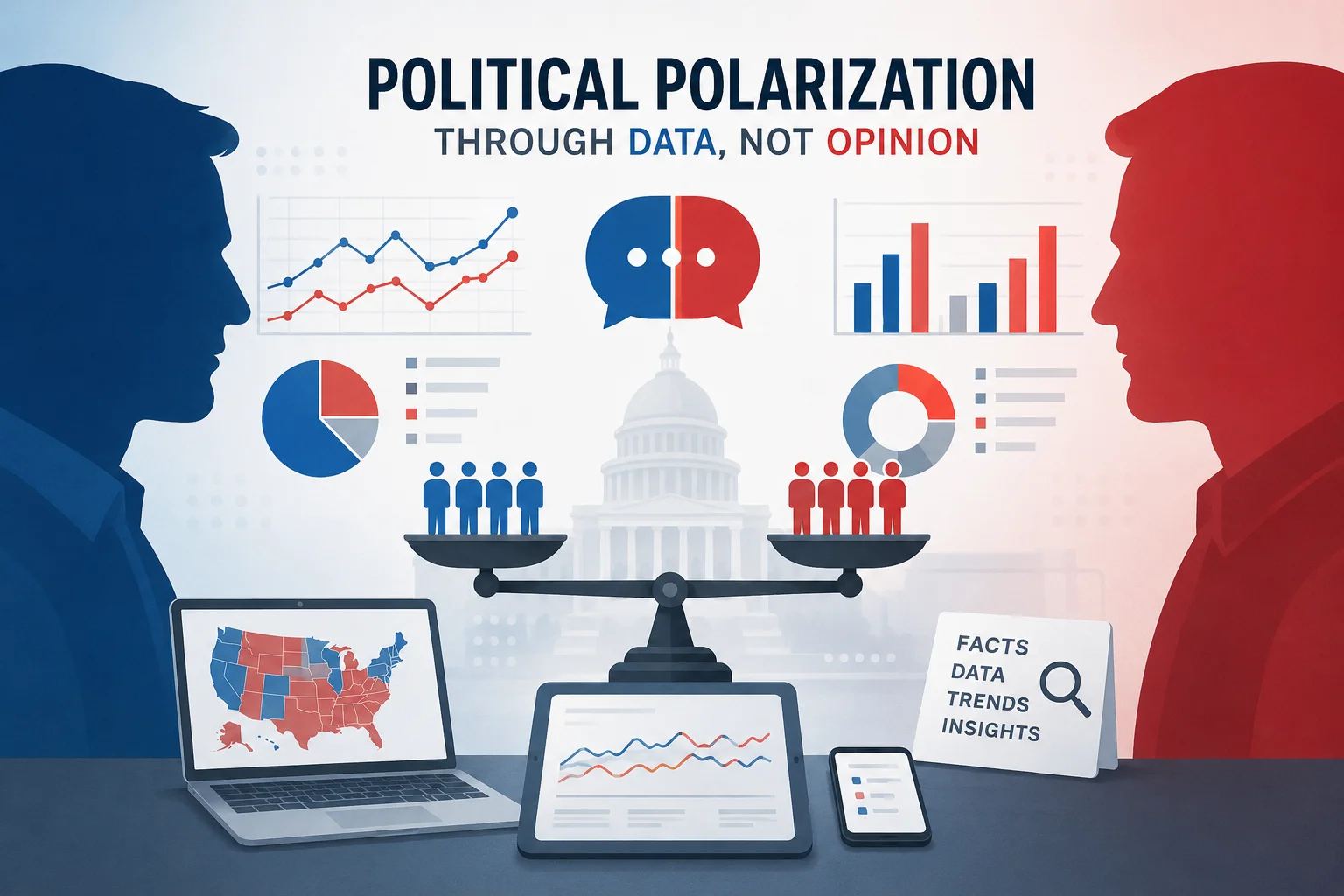
Political polarization means that people or groups become further divided into their political opinions.
Suppose a country where the majority of people have different opinions about tax rates, the education system, Medicare, or the environment. They may have different opinions, but they can still reach an agreement. Now suppose that these groups become more divided. One group strongly believes in one point of view, while the other group strongly believes the opposite. They may stop listening to each other and think that the other side is always incorrect. This is called political polarization.
Polarization can take place between two political groups, voters, regions, age groups, or social groups. Political polarization can also take place inside political parties. Participants of the same political party may become divided over important problems.
Why Should We Study Polarization With Data?
Most people understand politics through life experiences.
For Example:
Some people may say that
“Everyone around me is becoming more political,” while another person says that “People are not more divided. Social media just makes it look worse”.
Both ideas may seem fair, but they are still different views.
Data help the researchers to test these ideas. Rather than asking if people feel more divided, researchers can look at,
- Voting results.
- Voting trends.
- Survey replies.
- Online activities.
- Political contributions.
- Trust in political organizations.
- Opinion polls.
These are the different sources that can provide evidence about how political attitudes are shifting.
Election Result
Election results are the simplest way to study political polarization. Researchers can check voting results from different years. They can review whether voters are moving toward one political party or whether the challenges between parties become stronger.
The country still has political challenges, but the voting results individually do not prove that people have become more polarized.
Researchers also need to review the other information too. This provides them a deeper picture.
Opinion Polls
Opinion polls are also a very useful source of data. Experts ask groups of people about political problems. They ask questions about
- Political spending.
- Tax rates.
- Medicare.
- Climate change.
- Education.
- Trust in government.
- Foreign policy.
They compare the answers with several groups. If 85% of supporters of one political party support a policy while only 15% of supporters of another party support it, there is a large political difference.
Measuring Difference Between Political Views
Researchers can also find the distance between political groups. A simple way is to provide political opinions with numerical values.
For Example:
Consider a survey that asks people to rate their trust in government spending from 1 to 10. If one political party has an overall score of 4 and the other one gets a score of 6, in this case the difference is minor.
But if one party has an overall score of 4 and the other party has a score of 6, the difference is huge.
Experts can use the same method to check different political questions. This makes political attitudes into numbers which can be compared over time.
Social Media Data
Social media is another big source of political data. Lots of people post political opinions online.
Researchers can research,
- Which political topics are talked about.
- How quickly government messages expand.
- Which accounts people follow.
- How often people share different views.
These things help the researchers to understand opinions online regularly.
Types Of Polarization
The following are the several types of polarization:
Ideological Polarization
This occurs when
become more divided in their rules and beliefs.
Party Polarization
This occurs when political groups become more different from each other.
Emotional Polarization
It occurs when people get strong negative feelings towards members of another political party.
Geographic Polarization
It occurs when different areas strongly believe different political views.
Social Polarization
It occurs when political identity becomes connected with other parts of social life, like education, age, or identity.
Conclusion
Political polarization is a complicated issue. It cannot be fully understood through personal opinions, social media arguments, or political speeches alone. Election results can show voting patterns. Opinion polls can show what people believe. Legislative records can show how politicians vote. Social media data can show online behavior. Long-term surveys can show how political attitudes change over time. At the same time, data must be used carefully. Numbers can be incomplete or misleading if they are collected badly or presented without context. The best approach is to combine reliable data with careful thinking.
“For more insights on politics, business, and global news, visit Market Business Magazine.”
FAQ’s
1. What is political polarization?
Political polarization happens when people or political groups become more divided in their beliefs, opinions, and policies. The two sides may move farther apart and become less willing to find common ground.
2. Why is data important for understanding political polarization?
Data provides evidence about political behavior and opinions. It can show voting patterns, survey results, party differences, social media activity, and changes in political views over time.
3. How can elections show political polarization?
Election results can show whether voters are becoming more strongly connected to particular political parties. Researchers can compare results from different elections to identify changes in voting patterns.