







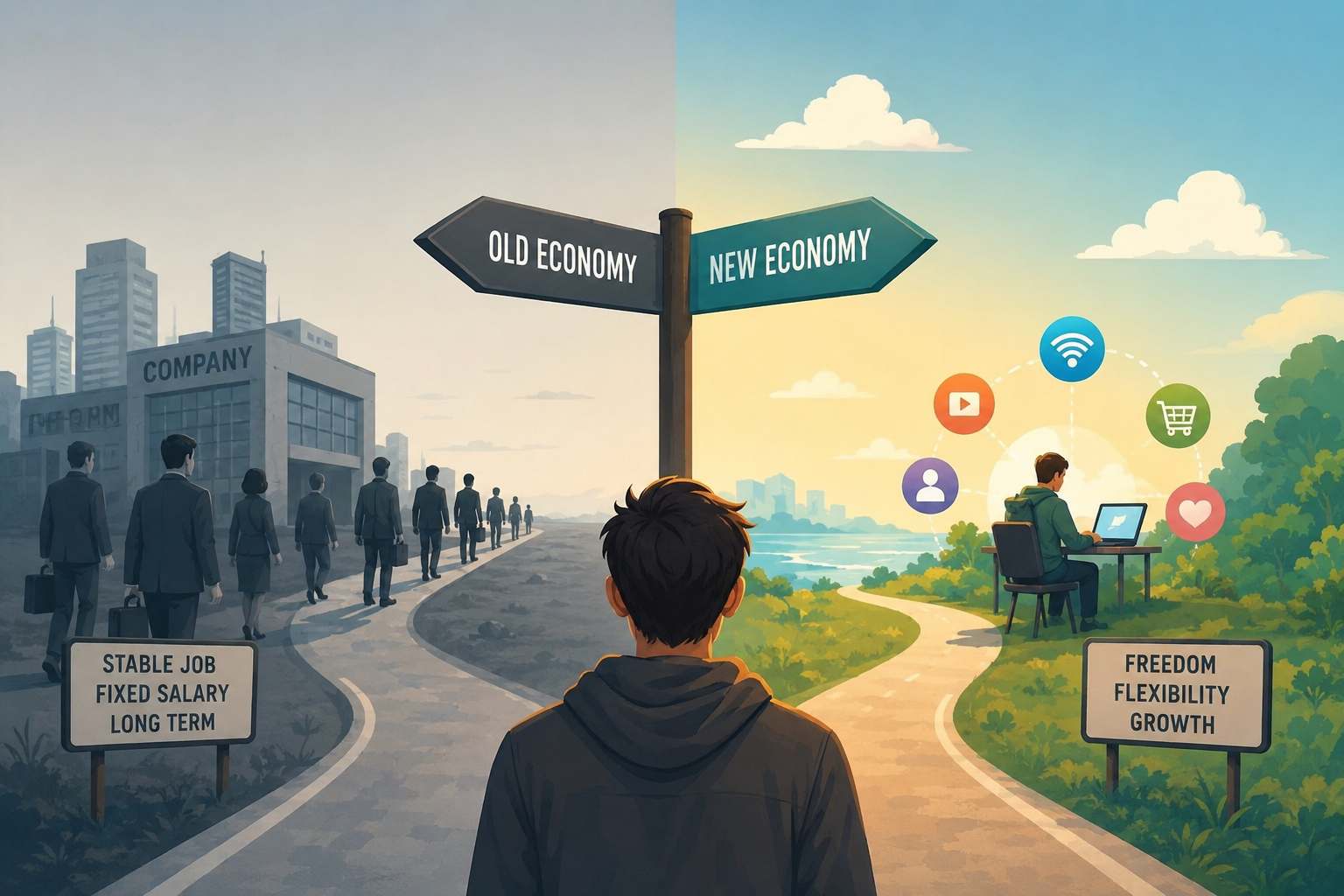
The old economic rules no longer work as reliably because 5 big shifts have changed how people borrow, work, spend and build careers: the end of near-zero interest rates, permanent hybrid work, artificial intelligence, reshaped supply chains and a housing market that keeps first-time buyers out for longer. Strategies that worked in the 2010s, such as relying on cheap debt, one lifelong employer or buying a home in your late twenties, now carry more risk or are simply out of reach. This guide explains each shift with current data and sets out the new rules for individuals and businesses.
Last updated: November 2026.
What Were the Old Economic Rules?
The old rules assumed cheap borrowing, stable careers with one employer, low-cost global supply chains and rising home ownership. For about a decade after the 2008 financial crisis, interest rates in the United States and Europe stayed close to zero. Debt was cheap, which lifted the prices of homes, shares and private businesses, and encouraged companies to borrow to grow. Supply chains were built for the lowest cost rather than resilience, and most office work happened in the office.
Each of those assumptions has been tested since 2020.
Shift 1: Why Did Cheap Money End?
Borrowing became much more expensive after inflation returned and central banks raised interest rates to fight it. US consumer price inflation peaked at 9.1% in June 2022. The Federal Reserve lifted its benchmark federal funds rate from near zero in early 2022 to a range of 5.25% to 5.50% by July 2023, the highest in more than two decades.
Rates did come down, but not to the old lows. After a series of cuts, the Fed’s target range stood at 3.50% to 3.75% at the end of 2025 and was held there through mid-2026. In September 2026 the Fed raised it again to 3.75% to 4.00%, and in October 2026 it held at that level, with inflation still above its 2% target. Our explainer on how central banks decide interest rates explains why.
What it means: mortgages, credit cards and business loans cost far more than in the 2010s, and the idea that rates will soon return to zero is no longer a safe planning assumption.
New rule: keep debt low, prefer fixed rates where you can, and build cash reserves before borrowing to grow.
Shift 2: Is Hybrid Work Here to Stay?
Yes. Remote and hybrid work settled at a level several times higher than before the pandemic. The WFH Research project run by economists Jose Maria Barrero, Nicholas Bloom and Steven Davis estimates that about 26% of paid full workdays in the United States in mid-2026 were worked from home. Before 2020, the share was in the single digits.
What it means: employers can hire across a wider area, workers compete with a wider pool of candidates, and city-centre office demand has changed.
New rule: results, digital communication and portable skills matter more than location.
Shift 3: How Is AI Changing the Rules?
AI is changing which tasks people do and which skills employers value. McKinsey’s 2025 global survey found that 88% of organisations now use AI regularly in at least one business function, up from 78% a year earlier, although most are still piloting rather than scaling it. The World Economic Forum’s Future of Jobs Report 2025 estimates that 170 million jobs will be created and 92 million displaced worldwide by 2030, a net gain of 78 million, but with large shifts in what those jobs involve. Read more in how AI is changing business and jobs in 2026.
What it means: routine writing, analysis, coding and support tasks are being automated or assisted, while judgement, client relationships and the ability to use AI tools well are rising in value.
New rule: learn the AI tools used in your field and update your skills every year.
Shift 4: Why Are Supply Chains Being Redesigned?
Companies are moving away from depending on single, distant suppliers. Pandemic shortages, shipping disruption, conflicts and tariffs showed how fragile lowest-cost supply chains can be. Many firms now add backup suppliers, hold more stock or move production closer to customers, known as nearshoring or reshoring. This improves resilience but usually raises costs. See how global supply chains actually work and our tariffs explainer.
New rule: businesses need more than one supplier for critical inputs and pricing that can absorb cost shocks.
Shift 5: Why Is Home Ownership Harder for Young Buyers?
High prices, higher mortgage rates and limited supply have pushed first-time buyers to record lows. The National Association of Realtors’ 2025 Profile of Home Buyers and Sellers found that first-time buyers made up just 21% of purchases, the lowest share since NAR began tracking in 1981, and their median age rose to a record 40. Before 2008, first-time buyers typically made up about 40% of sales.
New rule: plan longer for a deposit, compare the full cost of owning versus renting, and do not assume prices only rise.
Old Rules vs New Rules
| Area | Old rule (2010s) | New rule (2026) |
|---|---|---|
| Borrowing | Debt is cheap, so borrow to grow | Keep debt low and fixed where possible |
| Career | Stay with one employer | Build portable skills and more than one income source |
| Work location | Office every day | Hybrid and remote are normal |
| Skills | Learn once, use for decades | Update skills every year, including AI tools |
| Supply chains | Cheapest supplier wins | Resilience matters as much as cost |
| Housing | Buy early; prices always rise | Compare buying and renting carefully |
| Cash | Cash earns nothing, so invest it all | Cash reserves have value and earn interest again |
How Should Businesses Adapt to the New Economy?
Businesses adapt best by protecting cash, reducing single points of failure and investing in productivity. 6 practical moves:
- Stress-test borrowing against higher rates before taking on new debt.
- Hold 3 to 6 months of operating costs in reserve where possible.
- Diversify suppliers for critical materials and services.
- Review prices regularly so margins survive cost increases. Our article on how inflation reshapes purchasing power explains the customer side.
- Adopt AI where it saves real time, and train staff to use it.
- Offer flexible work to widen the hiring pool.
How Can Individuals Adapt?
- Build an emergency fund of 3 to 6 months of expenses. See how to build an emergency fund from scratch.
- Pay down high-interest debt first.
- Learn one new in-demand skill every year.
- Add a second income stream to reduce dependence on one employer.
- Invest regularly for the long term rather than trying to time markets.
For more practical steps, read how to manage finances in uncertain times.
Frequently Asked Questions
Why did interest rates rise so much?
Central banks raised rates to bring down high inflation, which peaked at 9.1% in the US in June 2022.
Will interest rates go back to zero?
No one can promise that. In late 2026 the Fed’s target range was 3.75% to 4.00% after a rise in September, so planning around near-zero rates is risky.
Is remote work here to stay?
The data suggest so. About a quarter of US paid workdays have been worked from home for several years running.
Will AI replace most jobs?
The WEF expects a net gain of jobs by 2030, but many roles will change, so ongoing training matters.
Sources
- US Bureau of Labor Statistics: Consumer Price Index
- Federal Reserve: Open market operations and federal funds rate decisions
- WFH Research: Survey of Working Arrangements and Attitudes
- World Economic Forum: Future of Jobs Report 2025
- McKinsey: The state of AI in 2025
- National Association of Realtors: 2025 Profile of Home Buyers and Sellers
This article is for general information only and is not financial advice.