








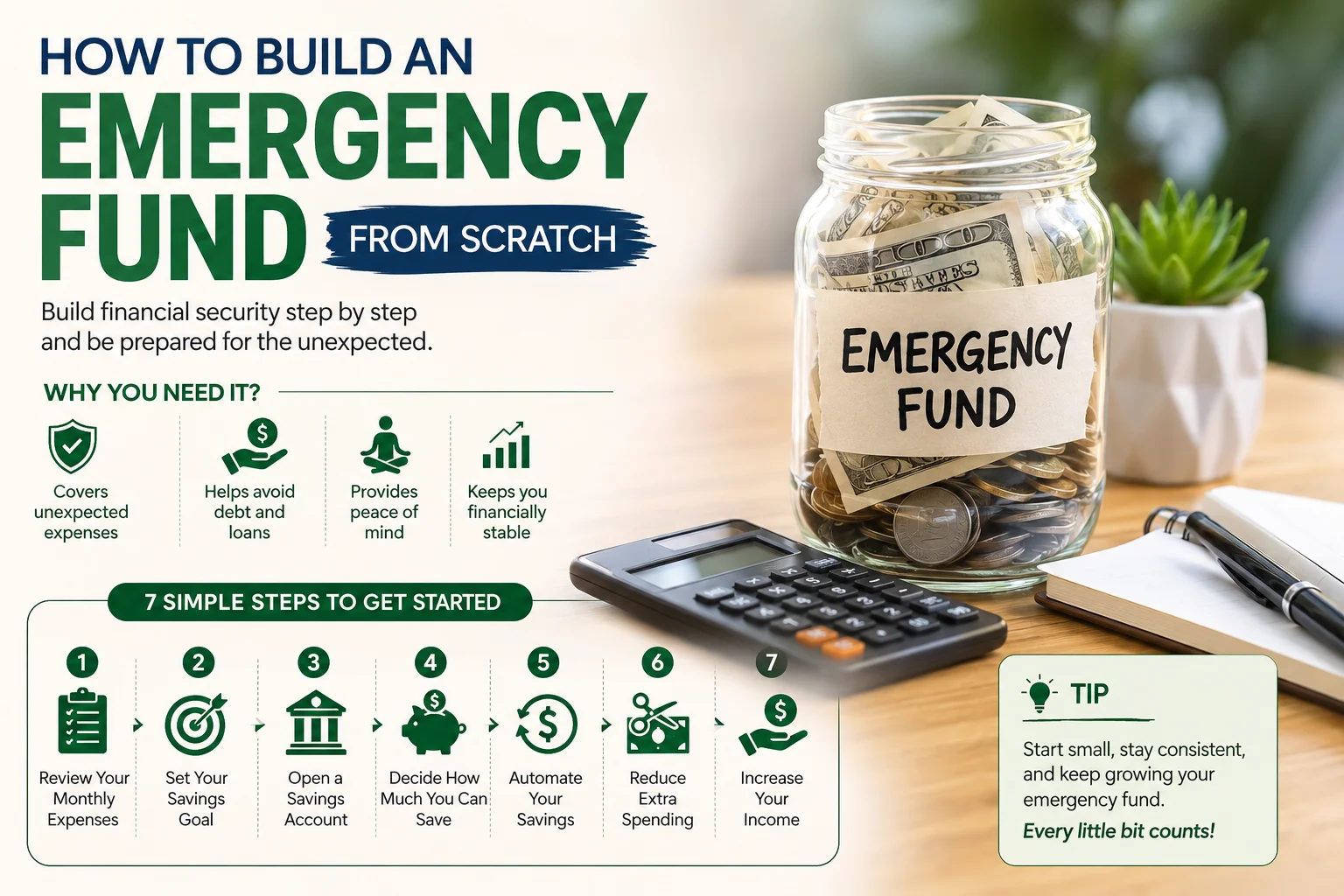
Unexpected costs can happen at any point, like car repairs, medical bills, or phone or laptop repairs. All these unplanned situations can be challenging, usually when you do not have any savings in your account. An emergency fund is the money you keep aside for unplanned expenses. It provides you money security and helps you reduce using credit cards and taking loans in an emergency.
The best part is that you do not need a huge amount to start. You can build an emergency fund gradually, even if your salary is not enough. The key point is to start and keep saving more regularly.
Emergency Fund
An emergency fund is the savings kept for unplanned and essential costs.
For Example:
You can use this emergency fund for,
- Unexpected car repairs.
- Necessary home repairs.
- Emergency medical costs.
- Reduced income.
- Important travel.
An emergency fund is not usually used for shopping, enjoyment, and regular monthly expenses. Keeping this money safe can make it easy to secure your finances for emergencies.
Why Do You Need an Emergency Fund?
Without an emergency fund, an unplanned bill becomes the main financial problem. Consider your home needs a $900 repair. If you do not have any savings, you have to borrow money from someone or use a credit card, which can create debt. But if you save an emergency fund, you can pay for repairs without any tension. An emergency fund not only saves you from loans, but it also gives you peace of mind.
Start With a Simple Goal
One of the major mistakes that people make is thinking that they need a huge amount to start, but that is not right. Your first goal should be simple and small. You can start with a little money and increase it over time. The exact amount may depend on your salary and monthly expenses.
A small emergency fund is better than not saving money at all. Once you achieve small goals, you can build it over time.

Steps Of Building an Emergency Fund
The following are some basic steps which helps you to build emerygeny funds with time:
Step 1:
Look at Your Monthly Expenses
Before reviewing, figure out how much to save, look over your daily expenses. Write down your monthly expenses, like rent, bills, food items, transportation, internet, debt, educational expenses, and other essentials.
You do not need to make your spending plan difficult and confusing. Check the amount you need every month to fulfill your basic needs.
This will help you to decide how much you should eventually save.
Step 2:
Pick Your Emergency Fund Target
A usual long-term goal is to save enough money to cover three to six months of important expenses.
For Example:
If your usual monthly expenditure is $3,000.
- In 3 months, it is $9000.
- In 6 months,s it is $18000.
You do not need to reach this amount simultaneously. If you are starting with a small amount, focus on increasing your savings over time.
Step 3:
Open a Savings Account
Open a separate savings account; it keeps your personal expenses and financial funds separate. If you keep your emergency funds and personal budget in the same account, you may be more likely to use them.
A separate savings account makes you think that the money is not for regular spending. Pick an account that is safe, simple to use, and matches your financial conditions.
Step 4:
Choose How Much You Can Save
It is not essential that you have to save a big amount every month. You can start with the amount you can easily afford. The amount is not as important as creating a regular habit.
You can save $10 in the first week, then $25 in the second week, $50 in the third week, and likewise, you can grow your savings over time.
Step 5:
Automate Your Savings
One of the simplest ways to build an emergency fund is to automate your savings. In this step, you set an automatic transfer from your personal account to the savings account after you get your salary.
This causes ease for you because you do not need to remember to do it every month or week.
Step 6:
Reduce Extra Spending
Look for the small possible ways to reduce your spending. It does not mean that you need to eliminate every form of entertainment from your life. You just need to find out the expenses that are not necessary and skip them. The main objective is not to make your life uncomfortable and sad. You just need to find possible ways of money to improve your savings.
Step 7:
Increase Your Earnings
Find ways to increase your savings. For this, you can improve your current income by doing side jobs; you can do an online job like freelancing, teaching, selling things online, or working extra hours at your current job. Even a little increase in income can make a huge difference.
Another way to increase your earnings is by adding extra money to your fund. You can add work bonuses, tax refunds, or a gift from your company to your savings account.

Conclusion
Building an emergency fund from scratch may seem difficult, especially when you are starting with $0. But you do not have to build it overnight. Start with a small goal. Create a simple budget. Open a separate savings account. Automate your contributions and look for small ways to save more. Even $10 or $20 saved regularly is progress. As your income increases, try to increase your savings too. When you use your emergency fund, focus on rebuilding it instead of feeling discouraged. The most important step is simply to start.
FAQ’s
How much money should I have in an emergency fund?
A common long-term goal is to save enough to cover three to six months of essential living costs. If you are starting from zero, begin with a smaller goal such as $500 or $1,000.
How can I start an emergency fund with a low income?
Start with a small amount that you can afford, even if it is only $5, $10, or $20 a week. Small savings can grow over time. You can also reduce unnecessary spending or look for ways to earn extra income.
Where should I keep my emergency fund?
Keep your emergency savings in a safe and easily accessible savings account. It is usually better to keep this money separate from your everyday spending account.