







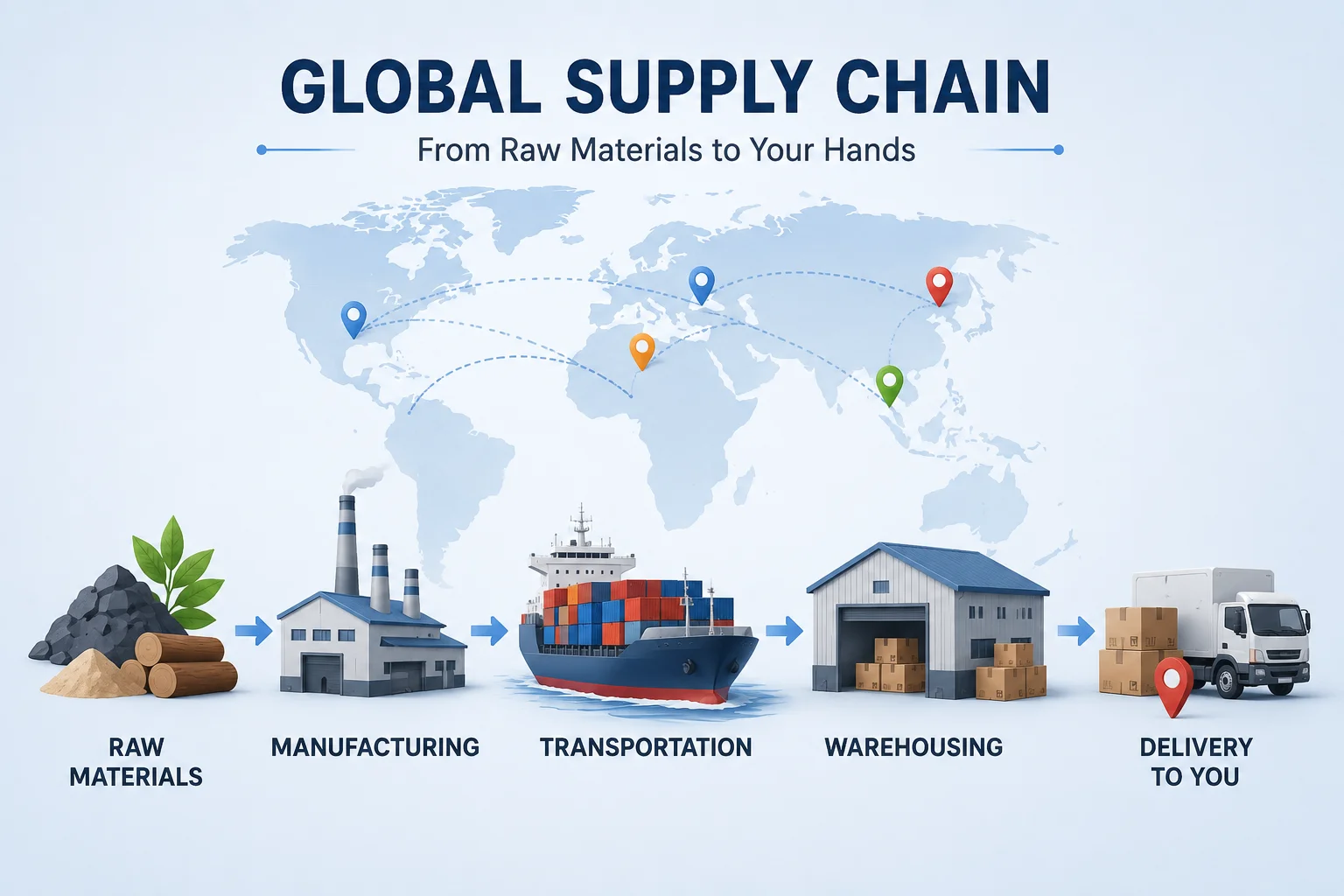
Daily, people purchase food items, clothes, vehicles, smartphones, and many different products, but do not think about where these products come from. We clearly go to a store and buy things, or order online. But before those products reach us, they travel a very long journey, which is called the Global Supply Chain. A global supply chain is a process in which the products are moved from the place where basic materials are found to the industries where they are produced, then to warehouses, retail stores, and finally reach the consumers. It combines many countries, industries, employees, and transportation. This article will guide you on how global supply chains work, why they are essential, which hurdles take place, and how to make them better.
Global Supply Chain
A global supply chain is a connection of people, industries, and transportation that work together to manufacture products and deliver them around the world. Rather than producing everything in one country, companies get help from different countries for different sections of the process.
For Example:
- Cotton is taken from India.
- The Fabric is made in China.
- The trousers are stitched in Vietnam.
- They are shipped through Singapore.
- And finally sold in America.
Different countries work together before the trousers reach the consumer.
Why Do Companies Need Global Supply Chains?
There are several reasons for using global supply chains, which are
- The major reason is cost-effectiveness. Some countries have reduced labor costs, which helps companies to minimize expenses and save money.
- Companies also use global supply chains to get easy access to raw materials, because some materials are only found in specific places.
- Companies also need industries with good skills and advanced machines. Some countries are very good at making toys, while others may be good at making clothing.
Working together with different countries helps the companies produce good products at minimal prices.
What Are the Major Steps of Global Supply Chains?
Every step is linked with the next one. If one step stops working, the whole production will be interrupted. The global supply chain process takes place in several steps, which include,
Step 1
Searching for input materials
The initial step is to find good-quality raw materials.
The basic examples of raw materials are
- Cotton.
- Wood.
- Oil.
- Copper.
- Rubber etc.
The team members find these materials from different areas. Without good raw materials, industries cannot produce products.
Step 2
Making Different Parts
To produce different products, numerous parts are required.
For Example:
To produce a smartphone, you need different parts like a battery, camera, screen, chips, buttons, speakers, and a processor.
All these parts are available in different countries. All these parts are sent to a factory where they are assembled properly to make products.
Step 3
Manufacturing
It is the step in which the parts are assembled into the final product. Different machines are used to make products. Large industries use a large amount of products every day. The product is reviewed to ensure that the product work correctly or not.
Step 4
Packaging
After production, the product is packed properly, which protects the product during shipping. Packages also include labels that indicate the name of the product, brand, capcode, and model. Effective packaging reduces the risk of damage during transportation.
Step 5
Transportation system
This is one of the major steps of the global supply chain. Products are transported through ships, trains, or airplanes. Ships carry a lot of products because they are less expensive, while transportation through airplanes is faster and more expensive.
Step 6
Storehouses
Products are stored in the warehouses before being sold. In warehouses, the products remain secure. Advanced warehouses use robots, computers, and advanced storage systems to find the products quickly.
Step 7
Distribution
In this step, the products are distributed from warehouses to different retail stores. Some are directly delivered to citizens’ homes when an order is placed online.
Step 8
Store Sales
Different stores, supermarkets, and malls sell these products to the consumers. Consumers choose the products and pay for them.
Step 9
Delivery to consumers
This is the last step of the global supply chain in which customers receive the products at home, offices, or stores when they order online. Now, quick delivery is very essential because most people now shop online.
Every step is linked with the next one. If one step stops working, the whole production will be interrupted.
Why Is Proper Planning Important?
Companies should make a proper plan before manufacturing products. They should check how many products customers will buy. If they find a higher demand for that product, they will produce more products. Good and clear planning always avoids shortages and loss, while poor planning can leave consumers waiting.
Conclusion
Global supply chains may seem complicated, but the basic idea is simple. They are the journey that products take from raw materials to the hands of customers. Along the way, farmers, miners, factory workers, shipping companies, warehouse employees, truck drivers, retailers, and many others all play an important role. Every product you use has its own story. It may have traveled through several countries before reaching your home. Modern technology, transportation, and teamwork allow millions of products to move around the world every single day.
Curious to explore more business and market insights like this? Visit Market Business Magazine for the latest trends and stories
FAQ’s
What is a global supply chain?
A global supply chain is a process in which products are moved from raw materials to industries, storehouses, and finally reach consumers.
Why do companies need global supply chains?
Companies use global supply chains because it helps to minimize expenses, get access to input materials easily, use specialized industries, and sell products globally.
What are the major steps of global supply chains?
The major steps of global supply chains are: gathering raw materials, manufacturing, packing products, shipping, storing, distribution to retail stores, and delivering to consumers.
Which factors can interrupt global supply chains?
Natural hazards, conflicts, strikes, poor weather conditions, factory issues, and slow transportation are the major factors that can disrupt global supply chains.