








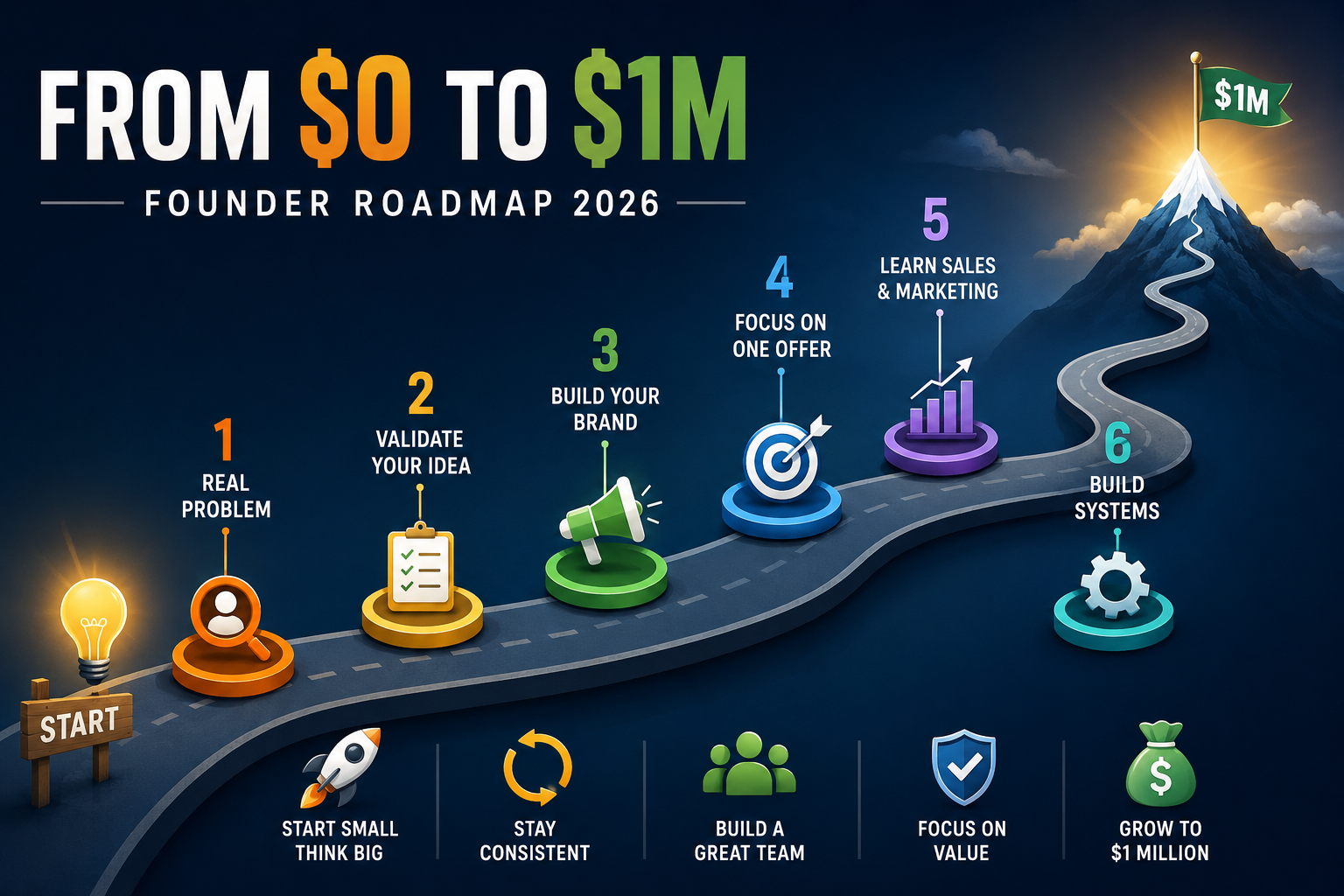
Scaling a business from $0 to $1 million in annual revenue usually happens in 4 stages: validate demand (up to about $10,000), build one repeatable sales channel (up to $100,000), add systems and your first hires (up to $500,000), then scale proven channels and a management layer (up to $1 million). Each stage needs a different focus from the founder. Trying to do stage 4 work at stage 1, such as hiring a team before customers pay, is one of the most common reasons young businesses run out of cash. This roadmap explains the goal, actions, numbers and warning signs at every stage.
Last updated: November 2026.
How Hard Is It to Reach $1 Million in Revenue?
Reaching $1 million in annual revenue is a milestone that most businesses never reach, because most stay as one-person operations. The US Small Business Administration’s Office of Advocacy counts about 36.2 million small businesses, built on Census Bureau data for 2022, and 29.8 million of them are nonemployer firms, meaning the owner has no paid staff. In other words, roughly 8 in 10 US small businesses are run by the owner alone.
Survival is the first hurdle. Bureau of Labor Statistics (BLS) data on business establishments born in March 2013 show the survival rate fell by 20.4 percentage points in the first year alone, and only 34.7% were still operating 10 years later. Growth to $1 million is therefore less about one big idea and more about surviving long enough to make a repeatable system work.
What Does $1 Million in Revenue Look Like in Customers?
$1 million a year equals about $83,333 in revenue every month. Breaking the target into customers makes it concrete and shows which business models reach it fastest:
| Business model | Average price | Customers or orders needed for $1 million a year |
|---|---|---|
| Subscription or SaaS | $100 per month | 834 active subscribers |
| Agency or consultancy retainer | $3,000 per month | 28 retained clients |
| Annual B2B contract | $2,000 per year | 500 clients |
| E-commerce store | $50 per order | 20,000 orders, about 1,667 a month |
| Local service business | $250 per job | 4,000 jobs, about 334 a month |
The table shows why pricing matters so much. A business selling a $50 product needs about 700 times more transactions than an agency charging $3,000 a month to reach the same revenue. Revenue is also not profit: a store with a 30% gross margin keeps far less of that $1 million than a consultancy with a 70% margin.
The 4 Stages From $0 to $1 Million at a Glance
| Stage | Annual revenue | Main goal | Founder focus | Typical team |
|---|---|---|---|---|
| 1. Validate | $0 to $10,000 | Prove people will pay | Selling and product | Founder only |
| 2. Repeat | $10,000 to $100,000 | Find 1 reliable sales channel | Marketing and sales | Founder plus freelancers |
| 3. Systemise | $100,000 to $500,000 | Document processes and hire | Operations and team | First 1 to 5 hires |
| 4. Scale | $500,000 to $1 million | Grow proven channels | Leadership and cash | Team with a manager or lead |
Stage 1: How Do You Validate Demand ($0 to $10,000)?
Validate demand by selling a simple version of your product to real customers before investing heavily in it. Interest, likes and compliments are not validation; payment is. CB Insights’ analysis of failed startups found that 35% cited no market need as a reason they failed, which is the exact risk this stage is designed to remove.
4 actions at this stage:
- Interview at least 20 potential customers about the problem, how they solve it today and what they spend on it.
- Sell a minimum version, such as a pilot service, a pre-order or a manual process behind a simple website.
- Charge from day one. Free users tell you little about willingness to pay.
- Register the business properly once money comes in. Our guide on how to register an LLC in the USA covers the steps.
Move on when: 10 or more customers have paid, at least some have bought again or referred someone, and you can explain in one sentence who buys and why.
Warning sign: every sale needs a long personal explanation or a big discount.
Stage 2: How Do You Build Repeatable Sales ($10,000 to $100,000)?
Find one marketing channel that brings customers predictably, then put most of your effort into it. Common channels are search engine optimisation, paid ads, referrals, partnerships, marketplaces and direct outreach. Testing 2 or 3 channels is sensible; running 8 at once usually means none works well. Our guide on how to build a digital marketing strategy that works explains how to choose.
Track 2 numbers from now on:
- Customer acquisition cost (CAC): total sales and marketing spend divided by new customers won.
- Customer lifetime value (LTV): average gross profit a customer generates before they stop buying.
A widely used rule of thumb is an LTV at least 3 times CAC. If you spend $300 to win a customer who generates $600 in gross profit, growth will drain cash; if that customer generates $1,200, each new customer funds the next one.
Move on when: you can predict roughly how many customers next month’s spend or effort will bring.
Warning sign: revenue depends on a single client who makes up more than a quarter of sales.
Stage 3: How Do You Systemise and Hire ($100,000 to $500,000)?
Document every repeatable process and hire people to run them, so the business no longer depends on the founder doing everything. This is the stage where many founders stall, because they are the bottleneck for sales, delivery and admin at the same time.
5 actions at this stage:
- Write simple standard operating procedures (SOPs) for sales calls, onboarding, delivery and support. A shared document or short screen recording is enough.
- Hire for the task that takes most of your time and earns the least, often customer support, operations or fulfilment.
- Automate invoicing, scheduling and follow-ups with accounting and CRM software.
- Set a monthly budget and review it against actual results. See how to create a business budget from scratch.
- Separate business and personal finances completely if you have not already.
For the legal side of the first hire, including payroll taxes and required registrations, read how to hire your first employee in the USA.
Warning sign: revenue grows but cash in the bank does not, usually because customers pay late or margins are too thin.
Stage 4: How Do You Scale to $1 Million ($500,000 to $1 Million)?
Invest more in the channels that already work, add a second channel and build a management layer so decisions do not all wait for the founder. The founder’s job shifts from doing the work to setting priorities, hiring well and managing cash.
4 actions at this stage:
- Double down on the proven channel before adding new ones.
- Add one new channel or product line that serves the same customers.
- Promote or hire a team lead for delivery or operations.
- Plan financing early. Growth often needs working capital for stock, staff or marketing before revenue arrives. Our guide to business loans in the USA explains the main options.
Which Numbers Should You Track at Each Stage?
| Metric | What it shows | Healthy direction |
|---|---|---|
| Monthly revenue and growth rate | Whether demand is rising | Steady month-on-month growth |
| Gross margin | Revenue left after direct costs | Stable or rising as you scale |
| LTV to CAC ratio | Whether customer acquisition pays for itself | About 3 to 1 or better |
| Cash runway | Months the business can run on current cash | At least 3 to 6 months |
| Customer retention | Share of customers who buy again or renew | Rising over time |
| Revenue per employee | How efficiently the team works | Rising as systems improve |
Cash deserves special attention. Many profitable businesses fail because money leaves before it arrives. Read how to manage cash flow before it manages you.
What Are the Biggest Mistakes When Scaling?
- Hiring before revenue is reliable. Salaries are fixed costs; uncertain revenue is not.
- Spreading marketing across too many channels instead of mastering one.
- Pricing too low. Low prices need far more customers to reach the same revenue, as the table above shows.
- Ignoring cash flow while chasing growth.
- Keeping every decision with the founder after the team grows.
- Skipping legal and insurance basics until a problem appears.
Some business models scale more easily than others. To judge yours, see what makes a business scalable, and for the traps that sink growing companies, read the real business collapse traps.
Frequently Asked Questions
How long does it take to reach $1 million in revenue?
There is no standard timeline. It depends on price point, market size, margins and funding. High-price B2B services can reach it with a few dozen clients, while low-price consumer products need thousands of orders.
Do I need outside funding to reach $1 million?
Not always. Many businesses grow from customer revenue alone. Funding can speed growth, but it adds repayment or gives away ownership, so it works best once the sales channel is proven.
When should I hire my first employee?
When repeatable work takes so much of your time that it blocks sales or growth, and revenue can cover the full cost of the role, including payroll taxes.
Which stage matters most?
Validation, because every later stage depends on real demand from paying customers.
Sources
- SBA Office of Advocacy: Frequently Asked Questions About Small Business, February 2026
- US Bureau of Labor Statistics: 34.7 percent of business establishments born in 2013 were still operating in 2023
- US Bureau of Labor Statistics: Business Employment Dynamics, establishment age and survival data
- CB Insights. The Top 12 Reasons Startups Fail, 2021.
This article is for general information only and is not financial, legal or tax advice.