







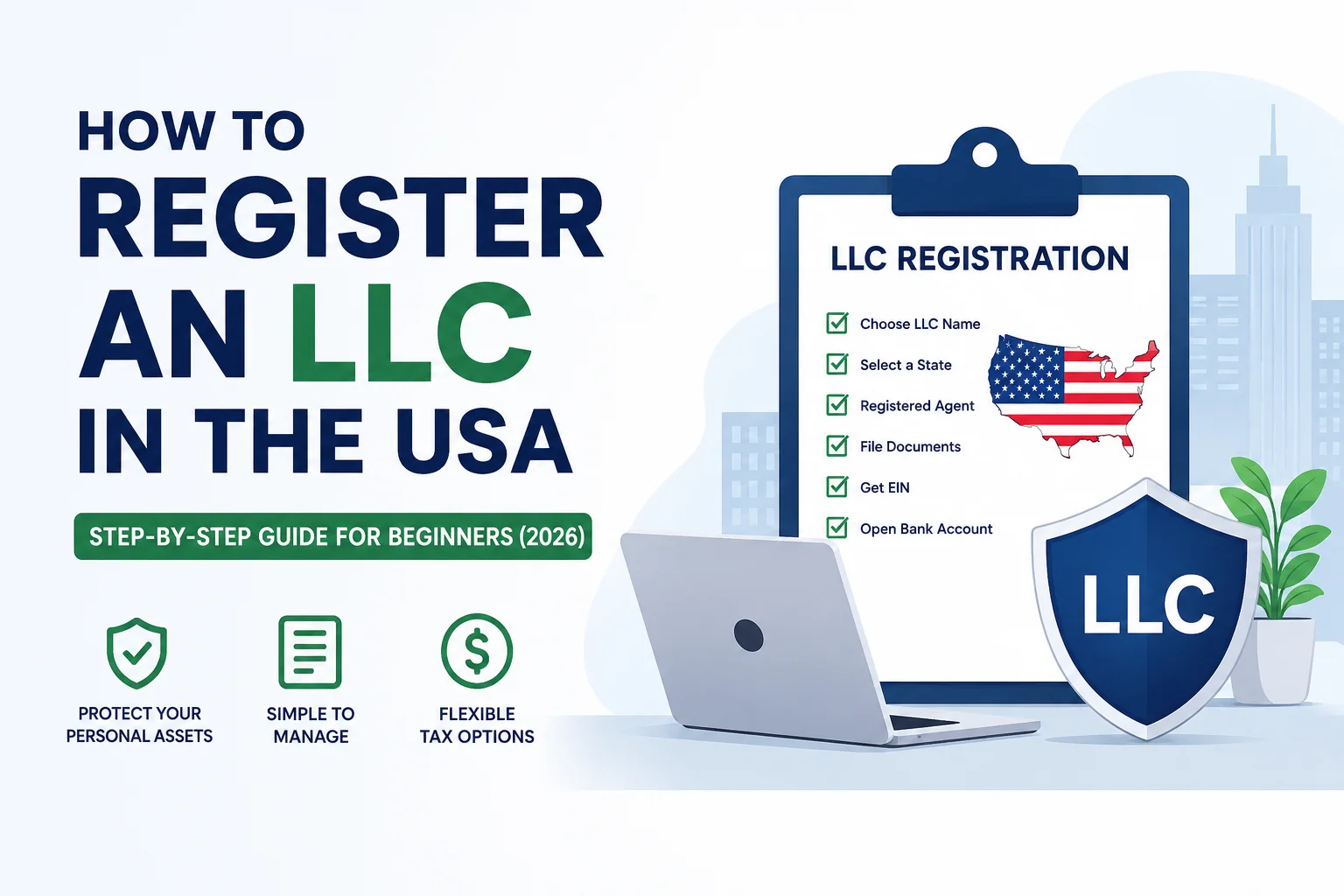
To register an LLC in the USA, you choose a state, pick an available business name, appoint a registered agent, file Articles of Organization with the state and pay the filing fee, write an operating agreement, get a free EIN from the IRS, open a business bank account and then keep the LLC in good standing with annual reports and taxes. State filing fees range from under $50 to about $500. This step-by-step guide explains each stage for beginners, including people who live outside the US.
What Is an LLC and Why Do Small Businesses Choose It?
A limited liability company (LLC) is a business structure created under state law that separates the business from its owners, who are called members. Its main advantage is limited liability: if the business is sued or cannot pay its debts, the members’ personal assets, such as their home and personal savings, are generally protected. That protection depends on keeping business and personal finances separate.
- Personal asset protection: business debts and lawsuits generally stay with the business.
- Flexible taxes: by default, a single-member LLC is taxed like a sole proprietorship and a multi-member LLC like a partnership, with profits reported on the owners’ personal tax returns. An LLC can also choose to be taxed as an S corporation or C corporation.
- Less paperwork than a corporation: no board of directors or annual shareholder meetings are required.
- Credibility: customers, suppliers and payment platforms often prefer dealing with a registered business.
Step 1: Which State Should You Form Your LLC In?
For most small businesses, the best choice is the state where you live and operate. Delaware, Wyoming and Nevada are popular for their business laws and privacy, but if you form there and operate in another state, you usually have to register in your home state too, as a “foreign LLC”, and pay fees and file reports in both. Forming elsewhere mainly makes sense for online businesses with no physical base, or for founders who live outside the US.
Step 2: How Do You Choose and Check an LLC Name?
Your LLC name must be different from other businesses already registered in that state, and most states require it to end with “LLC”, “L.L.C.” or “Limited Liability Company”. Words such as “bank” or “insurance” are usually restricted. Search your state’s business name database on the Secretary of State website, check that the matching domain name and social media handles are free, and search the US Patent and Trademark Office database to avoid trademark conflicts.
Step 3: What Is a Registered Agent and Do You Need One?
Every LLC must have a registered agent: a person or company with a physical address in the state of formation who accepts legal papers and official notices during business hours. You can act as your own agent if you have an address in that state, or pay a commercial registered agent service, which is required if you live outside the state or the country.
Step 4: How Do You File the Articles of Organization?
This is the step that actually creates your LLC. You file a document, usually called Articles of Organization or a Certificate of Formation, with the Secretary of State, most often online. It typically includes the LLC’s name and address, the registered agent’s details, and whether the LLC is managed by its members or by managers. You pay a one-time filing fee, which ranges from under $50 in some states to about $500 in others, and approval can take from a few minutes to several weeks.
Step 5: Why Do You Need an Operating Agreement?
An operating agreement is an internal document that sets out who owns the LLC, how profits and losses are shared, how decisions are made and what happens if a member leaves or dies. Only a few states require one, but it is strongly recommended even for single-member LLCs, because it helps prove the business is separate from you and prevents disputes. You do not file it with the state.
Step 6: How Do You Get an EIN for Your LLC?
An Employer Identification Number (EIN) is the LLC’s federal tax ID. You need it to open a business bank account, hire employees and file certain tax returns. It is always free from the IRS. If you have a US Social Security number, you can usually apply online and get the number immediately. If you do not, you can apply by fax or mail using Form SS-4. Avoid websites that charge for this free service.
Step 7: Why Should You Open a Separate Business Bank Account?
A separate account keeps business money apart from personal money, which makes bookkeeping and taxes easier and protects your limited liability. If you mix funds, a court may decide the LLC is not truly separate from you and hold you personally responsible for business debts. Banks usually ask for your approved Articles of Organization, EIN and identification. A business account is also the first step toward building business credit.
Step 8: Which Licenses, Permits and Taxes Apply?
Forming an LLC does not automatically give you permission to operate. Depending on your industry and location, you may need a city or county business license, a state sales tax permit if you sell taxable goods, and industry licenses for work such as food, construction or health services. Check your state and local government websites and the SBA’s licensing guide.
Step 9: How Do You Keep Your LLC in Good Standing?
- File annual or biennial reports and pay any state franchise tax or annual fee. California, for example, charges a minimum $800 annual franchise tax for most LLCs.
- Keep a registered agent at all times.
- File federal and state tax returns on time, according to how your LLC is taxed.
- Keep records of major decisions, contracts and finances.
Missing these deadlines can lead to fines and, eventually, the state dissolving your LLC.
Do You Still Need to File a Beneficial Ownership Report?
In March 2025, the Financial Crimes Enforcement Network (FinCEN) removed the beneficial ownership information (BOI) reporting requirement for companies created in the United States and their US owners. Companies formed outside the US that register to do business in a US state may still have to report. Rules in this area have changed several times, so check FinCEN’s BOI page for the current position.
Can Non-US Residents Form a US LLC?
Yes. You do not need to be a US citizen or resident to own an LLC. Non-residents typically use a commercial registered agent, apply for an EIN with Form SS-4 and then open a bank account with a bank or financial platform that accepts non-resident owners. Tax rules for foreign-owned LLCs are different, including extra IRS reporting for foreign-owned single-member LLCs, so speaking with a tax professional who works with international clients is strongly recommended.
What Mistakes Should Beginners Avoid?
- Forming in another state without realizing you must also register and pay fees in your home state.
- Mixing personal and business money.
- Skipping the operating agreement.
- Missing annual reports or franchise tax deadlines.
- Paying third-party sites for an EIN that the IRS issues for free.
- Choosing a name that conflicts with an existing trademark.
Conclusion
Registering an LLC is one of the simplest ways to give your business legal protection and credibility. Choose the right state, check your name, appoint a registered agent, file your Articles of Organization, sign an operating agreement, get a free EIN, open a business bank account, obtain the licenses you need and file your annual reports on time. Once your LLC is set up, our guide on how to start a profitable business covers the next steps.
This article is for general information only and is not legal or tax advice. Requirements and fees vary by state and change over time.
Frequently Asked Questions
How much does it cost to form an LLC?
State filing fees range from under $50 to about $500, plus any annual report fees or franchise taxes, and the cost of a registered agent service if you use one.
How long does it take to register an LLC?
Online filings are often approved within a few days, and some states approve them the same day. Mail filings can take several weeks.
Is an LLC better than a sole proprietorship?
An LLC adds personal liability protection and credibility for a small cost. A sole proprietorship is simpler and cheaper but offers no separation between you and the business.