






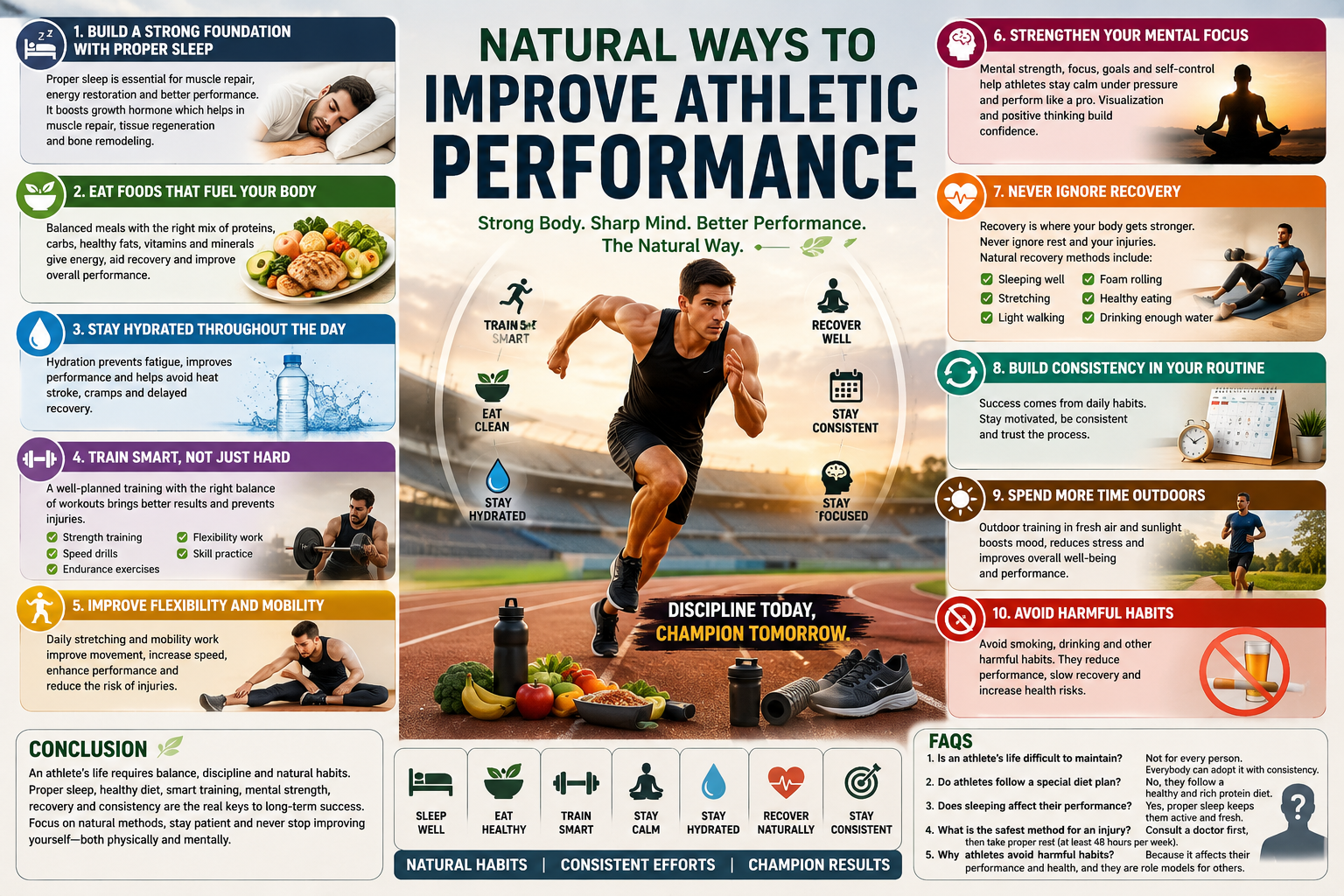
Smart training and natural recovery come down to 7 methods: planned training cycles, enough sleep, protein and carbohydrate refuelling, hydration, active recovery, soft-tissue work and rest days. Athletes improve during recovery, not during the workout itself. This guide explains each method, the research behind it and how to recognise overtraining.
What Is Smart Training?
Smart training means planning workload so athletes improve steadily without burning out or getting injured. Coaches use periodisation: dividing training into cycles that build intensity, then reduce it. A common pattern is 3 weeks of progressive training followed by 1 lighter deload week.
Why Is Recovery as Important as Training?
Training creates stress and small amounts of muscle damage, and recovery is when the body repairs and adapts. Without enough recovery, performance falls and injury risk rises.
1. How Does Sleep Affect Athletic Performance?
Sleep is the most powerful natural recovery tool. In a 2011 Stanford study by Cheri Mah and colleagues in the journal Sleep, college basketball players who extended their sleep to about 10 hours a night improved sprint times and increased free-throw and 3-point shooting accuracy by about 9%. Most athletes need at least 8 hours a night.
2. What Should Athletes Eat for Recovery?
Athletes need protein to repair muscle and carbohydrates to refill energy stores. The International Society of Sports Nutrition recommends 1.4 to 2.0 grams of protein per kilogram of body weight per day for most exercising people, with 20 to 40 grams per meal. Eat a meal with protein and carbohydrates within about 2 hours after training. Read how nutrition planning supports fitness goals.
3. How Much Should Athletes Drink?
Athletes should replace fluids so they do not lose more than 2% of body weight during exercise, the point at which the American College of Sports Medicine notes performance declines. Weighing before and after training shows how much fluid to replace: each 1 kg lost equals about 1 litre.
4. What Is Active Recovery?
Active recovery is light movement, such as easy cycling, swimming or walking, done on rest days or after hard sessions. It increases blood flow and helps athletes feel less stiff without adding significant training stress.
5. Do Foam Rolling and Massage Help?
Foam rolling and massage can reduce muscle soreness and help athletes feel recovered. A 2019 meta-analysis by Wiewelhove and colleagues in Frontiers in Physiology found small benefits of foam rolling for performance and perceived pain after exercise. Spend 30 to 60 seconds on each major muscle group.
6. Is Ice Bath Recovery a Good Idea?
Cold water immersion can reduce soreness, but regular use after strength training may limit muscle gains. A 2015 study by Roberts and colleagues in The Journal of Physiology found that regular cold water immersion after strength sessions reduced long-term gains in muscle mass and strength. Athletes focused on building muscle may prefer to avoid ice baths straight after weight training.
7. Why Are Rest Days Essential?
Rest days allow muscles, joints and the nervous system to recover. Most athletes need at least 1 full rest day per week, and young athletes should take regular breaks from their main sport, according to the American Academy of Pediatrics.
What Are the Signs of Overtraining?
6 warning signs suggest an athlete needs more recovery:
- Performance dropping despite consistent training.
- Persistent fatigue and heavy legs.
- Poor sleep.
- Higher resting heart rate than usual.
- Frequent illness or slow healing.
- Low motivation or irritability.
A Weekly Training and Recovery Plan
| Day | Plan |
|---|---|
| Monday | Hard training session |
| Tuesday | Moderate session plus mobility |
| Wednesday | Active recovery: easy swim or bike |
| Thursday | Hard training session |
| Friday | Light technique work |
| Saturday | Competition or long session |
| Sunday | Full rest |
For the mental side of performance, read sports psychology: what makes champions different.
Frequently Asked Questions
How much sleep do athletes need?
At least 8 hours, and more during heavy training.
What is the fastest way to recover after training?
Sleep, a meal with protein and carbohydrates, and fluid replacement are the most effective.
Should athletes take ice baths?
They can reduce soreness, but regular use after strength training may limit muscle growth.
How often should athletes rest?
At least 1 full rest day per week, with lighter weeks built into the training plan.
Sources
- Mah CD et al. The effects of sleep extension on the athletic performance of collegiate basketball players. Sleep, 2011.
- Jäger R et al. ISSN Position Stand: protein and exercise, 2017.
- American College of Sports Medicine. Exercise and fluid replacement, 2007.
- Wiewelhove T et al. A Meta-Analysis of the Effects of Foam Rolling on Performance and Recovery. Frontiers in Physiology, 2019.
- Roberts LA et al. Post-exercise cold water immersion attenuates acute anabolic signalling and long-term adaptations in muscle to strength training. The Journal of Physiology, 2015.