








The future of technology will be shaped by 7 fields: artificial intelligence, quantum computing, next-generation connectivity, gene editing and biotechnology, clean energy, robotics and spatial computing such as augmented reality. Several have already moved from research labs into real products. This guide explains what each technology is, where it stands today, how it may change daily life and the risks and rules that come with it.
1. How Will Artificial Intelligence Change the Future?
Artificial intelligence is the fastest-spreading technology of the decade, moving into search, work software, healthcare, education and customer service. OpenAI released ChatGPT on November 30, 2022, and the service was estimated by analysts at UBS to have reached 100 million users within about 2 months, one of the fastest adoptions of any consumer app. Businesses now use AI to draft content, write code, analyse data and automate support. Read how AI is changing business and jobs in 2026.
2. What Is Quantum Computing?
Quantum computers use quantum bits, or qubits, to solve certain problems far faster than ordinary computers. Potential uses include drug discovery, materials science, logistics and cryptography. In December 2024, Google announced its Willow chip with 105 qubits, which showed that errors can fall as more qubits are added, an important step towards practical machines. Useful large-scale quantum computers are still expected to be years away.
3. What Comes After 5G?
5G networks are expanding worldwide, and research on 6G is under way, with commercial launches commonly expected around 2030. Faster, lower-latency connections support connected cars, smart cities, remote surgery and large networks of internet-connected devices.
4. How Is Gene Editing Changing Medicine?
Gene editing tools such as CRISPR allow scientists to change DNA precisely, opening new treatments for inherited diseases. In late 2023, regulators in the United Kingdom and the United States approved Casgevy, the first CRISPR-based therapy, for sickle cell disease and, later, beta thalassaemia. Researchers are now testing gene editing for other genetic conditions.
5. How Will Clean Energy Technology Develop?
Solar power, wind power and batteries are growing rapidly as their costs fall. Cheaper batteries also power the shift to electric vehicles. BloombergNEF reported that average battery pack prices fell 20% in 2024. Read why electric cars are the future of mobility.
6. What Role Will Robots Play?
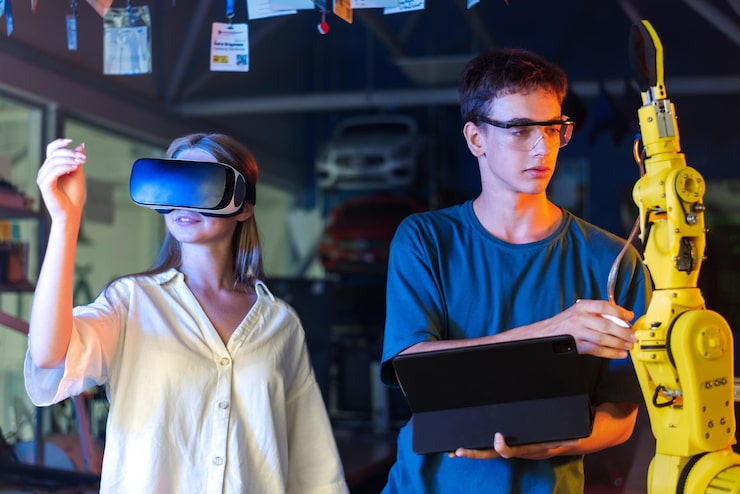
Robots are moving from factory floors into warehouses, hospitals, farms and homes. Advances in AI help robots see, move and handle objects more flexibly. Humanoid robots are being tested by several technology and car companies, while robot vacuums and delivery robots are already common.
7. What Is Spatial Computing?
Spatial computing blends digital content with the physical world through augmented reality (AR) and virtual reality (VR) headsets and glasses. Apple released its Vision Pro headset in the United States in February 2024, and other companies are developing lighter smart glasses. Uses include training, design, remote collaboration and entertainment.
Future Technologies at a Glance
| Technology | Status today | Likely impact |
|---|---|---|
| Artificial intelligence | Widely used | Work, search, healthcare, education |
| Quantum computing | Early experimental systems | Drug discovery, materials, security |
| 5G and 6G | 5G expanding, 6G in research | Connected devices and cities |
| Gene editing | First approved therapies | Treatment of genetic diseases |
| Clean energy and batteries | Rapid growth | Electricity, transport, emissions |
| Robotics | Growing beyond factories | Logistics, care, agriculture |
| Spatial computing | Early consumer devices | Training, design, entertainment |
How Will Future Technology Affect Jobs?
New technology will both create and replace jobs. The World Economic Forum’s Future of Jobs Report 2025 estimated that 170 million new jobs will be created and 92 million displaced by 2030, a net gain of 78 million jobs. Demand is growing fastest for skills in AI, data, cybersecurity and technology literacy. See the best online skills to learn for high income.
What Are the Risks of Future Technology?
Powerful technologies bring 4 main risks: privacy loss from data collection, misinformation from AI-generated content, cybersecurity threats and unequal access between countries and communities. Governments are responding with new rules. The European Union’s AI Act, the first comprehensive law on artificial intelligence, entered into force on August 1, 2024.
Frequently Asked Questions
What is the most important future technology?
Artificial intelligence, because it is already being used across almost every industry.
When will quantum computers be useful?
Large, error-corrected quantum computers are still expected to be several years away, though progress is accelerating.
Will technology take away jobs?
Some jobs will disappear, but the WEF expects a net gain of 78 million jobs by 2030.
What is the EU AI Act?
The EU AI Act is the first comprehensive law regulating artificial intelligence, which entered into force on August 1, 2024.
Sources
- UBS analysis of ChatGPT user growth, 2023.
- Google Quantum AI. Willow chip announcement, December 2024.
- US Food and Drug Administration and UK MHRA. Casgevy approvals, 2023.
- BloombergNEF. Lithium-ion battery price survey, 2024.
- World Economic Forum. Future of Jobs Report 2025.
- European Union. Artificial Intelligence Act.