








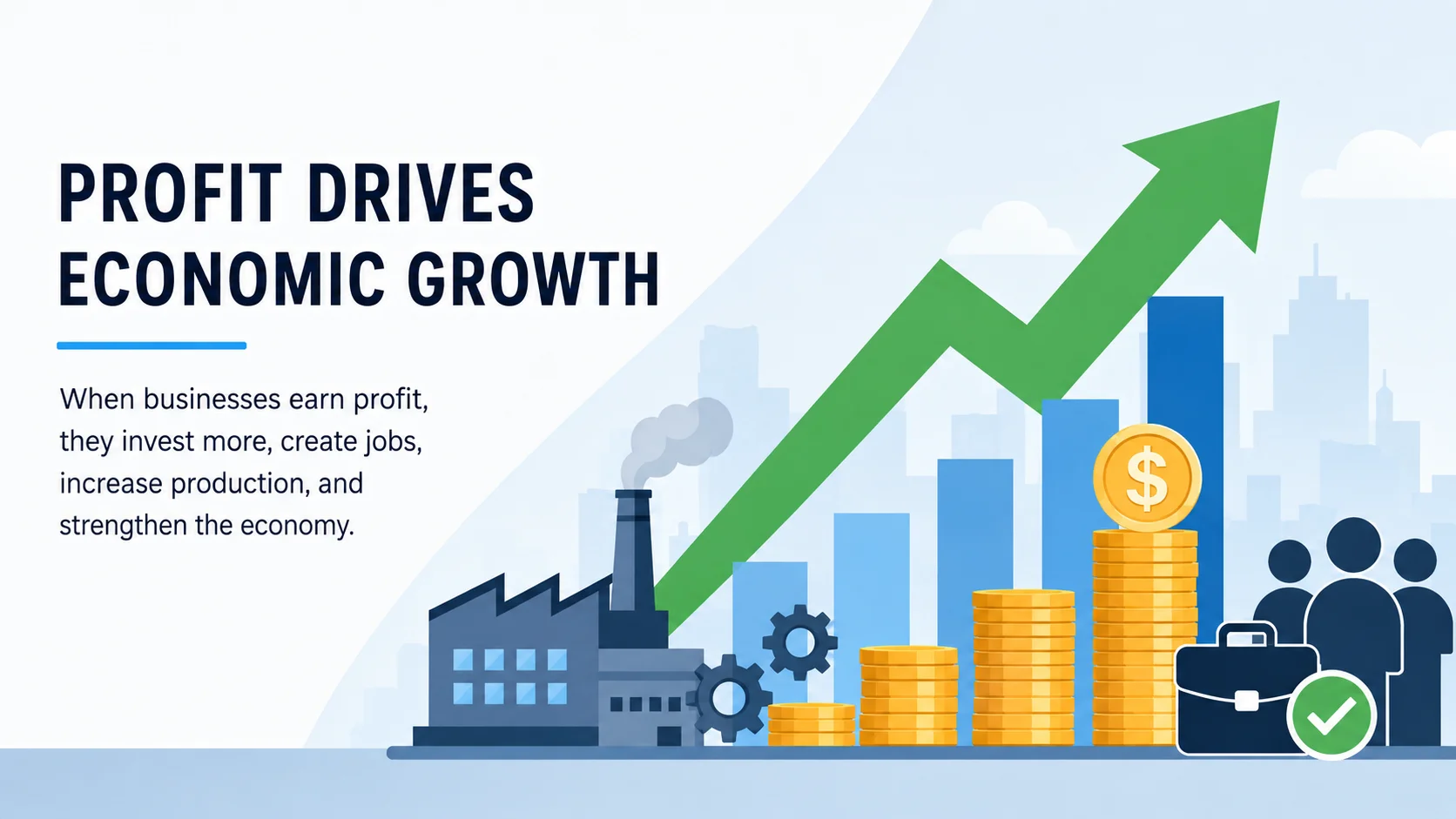
Business shapes a country’s economic future through 3 connected forces: profit, which funds investment, jobs and innovation; policy, the taxes, laws and regulations that set the rules businesses play by; and power, the influence large companies hold over prices, workers, suppliers and even lawmaking. When the 3 are in balance, profitable firms invest, competition keeps prices fair and rules protect workers and consumers. When they fall out of balance, the result can be weak investment, monopolies or rules written for the few. This guide explains how each force works, with real examples, and where the main trade-offs lie.
Last updated: November 2026.
How Does Profit Drive Economic Growth?
Profit is the money a business keeps after paying all its costs, and it is the main source of funds for new investment. A profitable company can buy equipment, open new locations, hire staff and fund research. Those choices create jobs, pay wages that are spent elsewhere in the economy and generate tax revenue for public services. When profits are weak or uncertain, businesses tend to delay investment, freeze hiring and cut costs, which slows growth across the economy.
Profit also acts as a signal. High profits in a market attract new competitors, which pushes prices down and quality up. That process only works if new firms can actually enter the market, which is where policy and power come in.
Which Types of Business Investment Matter Most?
| Type of investment | Economic effect |
|---|---|
| New locations or factories | Creates jobs and supports local suppliers |
| Machinery, software and technology | Raises productivity, so more is produced per hour worked |
| Research and development | Leads to new products, medicines and processes |
| Training and skills | Builds a more capable workforce and higher wages |
| Investment in underserved regions | Spreads jobs and infrastructure to areas that need growth |
Small businesses matter as much as large ones. The US Small Business Administration’s Office of Advocacy counts about 36.2 million small businesses, which account for almost half of private-sector employment. Their combined investment decisions, often funded from retained profits or small loans, shape local economies everywhere.
How Do Government Policies Shape Business?
Governments set the conditions under which businesses earn and spend profits. The main levers are:
| Policy area | What it does | Example |
|---|---|---|
| Tax policy | Decides how much profit firms keep to reinvest and how much funds public services | The US federal corporate income tax rate has been 21% since 2018 |
| Interest rates (monetary policy) | Sets the cost of borrowing for investment | The Federal Reserve raised rates sharply in 2022 and 2023 to fight inflation |
| Trade policy | Shapes import costs and export markets through tariffs and trade deals | US tariffs announced in 2025 and 2026 |
| Competition (antitrust) law | Prevents monopolies, cartels and unfair practices | US Sherman Act and Clayton Act; EU competition rules |
| Labour law | Sets minimum wages, safety rules and anti-discrimination protections | Federal and state minimum wage laws |
| Environmental rules | Limits pollution and requires disclosure | EU Corporate Sustainability Reporting Directive |
| Financial regulation | Keeps banks and markets stable | Bank capital requirements |
For more detail, see our explainers on how central banks decide interest rates, how tariffs work and how modern banks manage risk and regulation.
How Much Power Do Large Companies Have?
Large companies, especially multinationals and big technology platforms, have significant influence over markets, workers and policy. That influence shows up in 4 main ways:
- Market power: dominant firms can influence prices, set industry standards and decide which suppliers and partners succeed.
- Employment: they employ large workforces directly and support many more jobs through suppliers.
- Supply chains: they connect producers and distributors across many countries. See how global supply chains work.
- Political influence: through lobbying, industry associations and campaign spending, large firms can shape laws and regulations.
Scale brings real benefits, such as large-scale investment, global reach and lower prices through efficiency. Problems arise when a company becomes so dominant that it can block rivals, raise prices or shape the rules in its own favour.
How Is Corporate Power Checked? A Real Example
Competition law is the main tool for checking market power. A recent example is the US Department of Justice’s search case against Google. In August 2024, Judge Amit Mehta ruled that Google had unlawfully maintained a monopoly in general search services and search text advertising. In his September 2025 remedies ruling, he rejected the government’s request to force a sale of the Chrome browser or Android, and allowed default-search payments to continue, but ordered Google to share some search index and user-interaction data with competitors. The judge cited the rapid rise of generative AI as a reason to avoid more drastic measures.
The case shows how policy and power interact: courts and regulators try to restore competition without harming the innovation and consumer benefits that large firms can deliver.
Where Do Profit, Policy and Power Conflict?
The main debates are about where to strike the balance, and reasonable people disagree.
| Issue | Argument for lighter rules | Argument for stronger rules |
|---|---|---|
| Taxes | Lower taxes leave more profit to invest and hire | Taxes fund infrastructure, education and services businesses rely on |
| Regulation | Fewer rules cut costs and speed up growth | Rules protect workers, consumers and the environment |
| Big tech and market concentration | Scale delivers free services and fast innovation | Dominance can block new competitors and raise prices |
| Automation and AI | Productivity gains raise living standards over time | Workers need support and retraining as jobs change |
| Environment | Voluntary action and innovation work better than mandates | Without rules, pollution costs are pushed onto the public |
Most economies try to find a middle ground, and where that line sits is one of the central questions in politics. For one side of the debate on purpose and profit, see the new business equation: profit meets purpose; for how AI changes the picture, read how AI is changing business and jobs.
What Does This Mean for Business Owners?
- Track policy changes in taxes, tariffs and interest rates that affect your costs.
- Diversify suppliers and sales channels so one dominant partner cannot squeeze your margins.
- Reinvest profits deliberately in productivity, skills and technology.
- Join trade associations so small-business views are heard when rules are written.
- Stay compliant with labour, privacy and environmental rules; fines and reputational damage cost more than compliance.
Frequently Asked Questions
Why is profit important for economic growth?
Profits give businesses the money and confidence to invest, hire and innovate, which raises output and incomes across the economy.
Why do governments regulate businesses?
To keep competition fair, protect workers, consumers and the environment, maintain financial stability and collect taxes for public services.
What is antitrust law?
Antitrust, or competition, law stops companies from creating or abusing monopolies, fixing prices or using unfair practices to block rivals.
Was Google broken up in the search antitrust case?
No. The September 2025 remedies ruling rejected a forced sale of Chrome or Android but required Google to share some search data with competitors.