








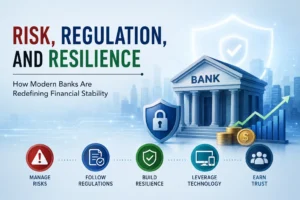
Modern banks stay stable by managing four main risks (credit, liquidity, market and operational, including cyber risk), by meeting regulatory rules on capital and liquidity, and by building resilience through stress testing, recovery planning and secure technology. Regulators require banks to hold enough capital to absorb losses and enough liquid assets to survive a sudden wave of withdrawals, lessons reinforced by the 2008 financial crisis and the 2023 collapse of Silicon Valley Bank. This guide explains each risk, the key regulations and how technology is changing banking stability.
Why Does Banking Stability Matter?
Banks keep people’s savings, lend to households and businesses and move money around the economy. When a bank fails, depositors can lose access to their money, businesses lose credit and panic can spread to other banks. That is why governments supervise and regulate banks closely, and why public trust is so important to the financial system.
What Are the Main Risks Banks Face?
| Risk | What it means | How banks manage it |
|---|---|---|
| Credit risk | Borrowers fail to repay loans | Careful lending checks, diversified loan books, loss reserves |
| Liquidity risk | The bank cannot meet withdrawals or payments quickly enough | Holding cash and easy-to-sell assets, stable funding, emergency credit lines |
| Market risk | Losses from changes in interest rates, currencies or asset prices | Hedging, limits on exposures, regular stress tests |
| Operational risk | Losses from system failures, human error or fraud | Strong internal controls, staff training, backup systems |
| Cyber risk | Hacking, data theft and service disruption | Encryption, multi-factor authentication, monitoring, incident response plans |
What Happened at Silicon Valley Bank?
In March 2023, Silicon Valley Bank failed after a rapid bank run. It had invested heavily in long-term bonds that lost value as interest rates rose, and many of its large depositors were uninsured and withdrew money quickly once concerns spread online. US authorities stepped in to protect all depositors. The case showed how interest rate risk and liquidity risk can combine quickly in the age of mobile banking and social media.
How Does Regulation Keep Banks Stable?
- Capital requirements: international standards known as Basel III, set by the Basel Committee on Banking Supervision, require banks to hold minimum levels of high-quality capital so they can absorb losses.
- Liquidity rules: banks must hold enough liquid assets to cover expected outflows during a short stress period, and maintain stable long-term funding.
- Stress tests: regulators such as the US Federal Reserve test whether large banks could survive severe economic scenarios.
- Deposit insurance: in the US, the FDIC insures deposits up to $250,000 per depositor, per insured bank, for each account ownership category, which reduces the risk of panic.
- Supervision and reporting: regular examinations and public disclosures keep banks accountable.
- Consumer protection and anti-money-laundering rules: protect customers and stop the financial system being used for crime.
What Does Resilience Mean for a Bank?
Resilience is a bank’s ability to keep operating, or recover quickly, when something goes wrong. It includes recovery and resolution plans (sometimes called “living wills”) that explain how a large bank could be wound down without harming the wider system, backup systems and data centers, and tested plans for cyberattacks and outages. In the European Union, the Digital Operational Resilience Act (DORA) now sets specific standards for how financial firms manage technology risks.
How Is Technology Changing Banking Stability?
Artificial Intelligence
AI helps banks analyze large volumes of transactions in real time to detect fraud, assess credit risk and flag unusual activity. It also creates new risks, such as biased lending decisions or errors that are hard to explain, so regulators expect human oversight.
Cloud Computing
Cloud services can make bank systems more flexible and easier to recover after failures. At the same time, reliance on a few large cloud providers creates concentration risk, which regulators are watching closely.
Data Analytics
Advanced analytics help banks monitor risks, forecast cash needs, understand customers and spot problems early, as McKinsey’s research on banking technology describes.
Digital Banking
Mobile and online banking let customers move money instantly from anywhere. This is convenient, but it also means deposits can leave a bank much faster during a crisis, which is why liquidity planning has become even more important.
Conclusion
Banking stability depends on managing risk well, meeting strong regulatory standards and building resilience against shocks. Capital and liquidity rules, stress tests, deposit insurance and supervision protect customers and the wider economy, while technology brings both new tools and new risks. For more on how the financial system works, read how central banks decide interest rates and our guide to portfolio diversification in uncertain markets.
Frequently Asked Questions
Is my money safe in a bank?
In the US, deposits at FDIC-insured banks are protected up to $250,000 per depositor, per bank, for each ownership category. Many other countries have similar deposit insurance schemes with their own limits.
What is Basel III?
Basel III is a set of international banking standards introduced after the 2008 financial crisis to strengthen banks’ capital, liquidity and risk management.
Why do banks fail?
Banks usually fail because of large loan losses, poor management of interest rate risk, or a loss of confidence that triggers rapid withdrawals they cannot meet.