








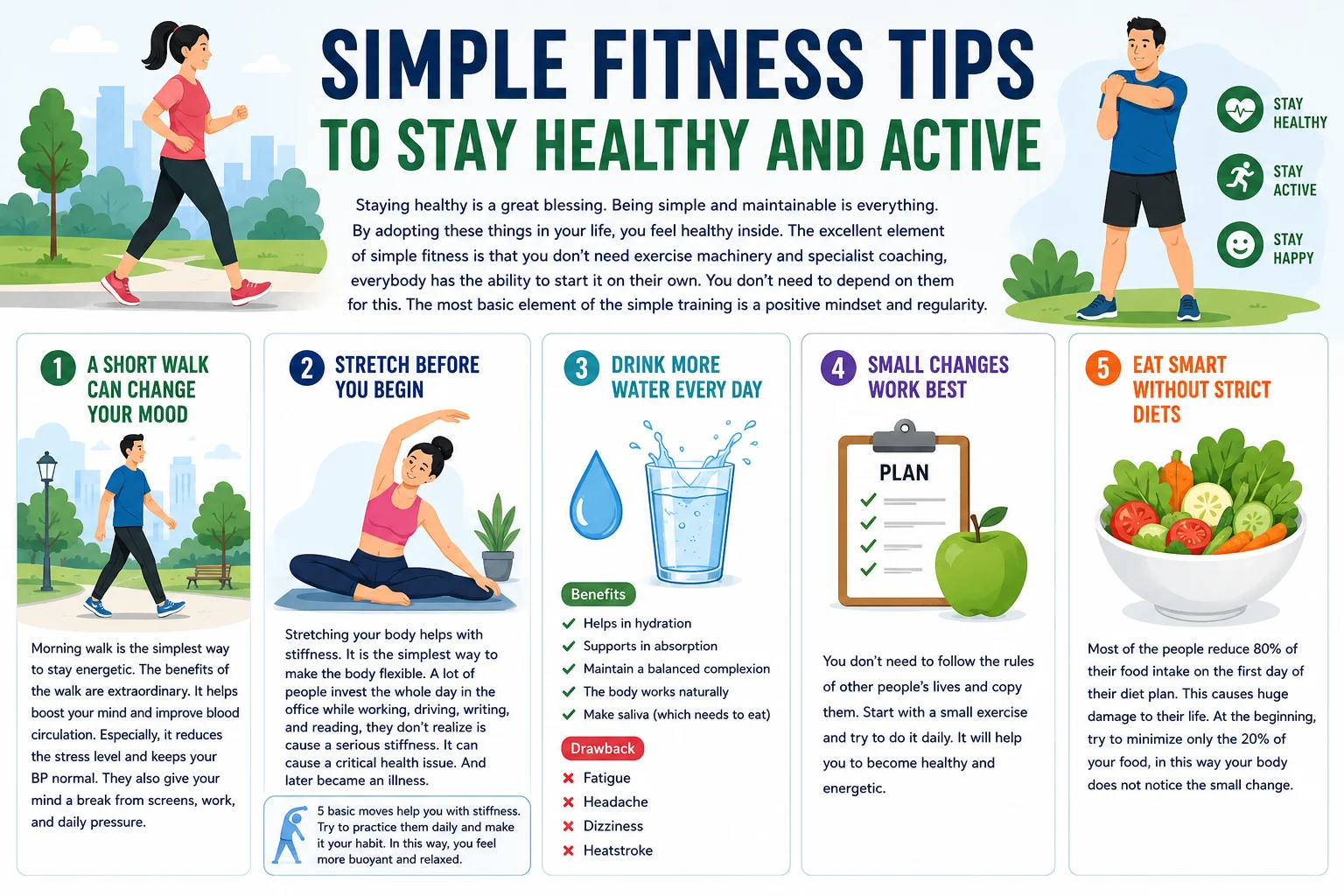
Beginners stay fit and active most reliably with 9 simple fitness tips: start with walking, follow the 150-minute weekly target, add 2 strength sessions, use the talk test to judge intensity, warm up and cool down, increase gradually, schedule workouts, rest and sleep, and track progress. The goal for a beginner is not a perfect programme but a routine that lasts. This guide explains each tip and gives a 4-week starter plan.
How Much Exercise Does a Beginner Need?
Beginners should build towards 150 minutes of moderate activity per week plus 2 days of muscle-strengthening exercise, the target set by the World Health Organization and the CDC. Starting below this target is fine. The WHO’s 2020 guidelines state that some physical activity is better than none, and that every bit of movement counts.
1. Why Is Walking the Best Place to Start?
Walking is the best starting exercise because it is free, low-impact and easy to repeat every day. A 2021 study by Paluch and colleagues in JAMA Network Open found that middle-aged adults taking at least 7,000 steps a day had a 50% to 70% lower risk of early death than those taking fewer.
Start with 10 to 15 minutes a day and add 5 minutes each week.
2. How Do You Know if Exercise Is Moderate Intensity?
Use the talk test: during moderate activity you can talk but not sing; during vigorous activity you can say only a few words without pausing for breath. The CDC recommends this simple method because it needs no equipment or heart rate monitor.
3. How Often Should Beginners Do Strength Training?
Beginners should do strength training on 2 non-consecutive days per week, working all major muscle groups. 5 beginner exercises cover the whole body:
- Chair squats: 2 sets of 10
- Wall or incline push-ups: 2 sets of 8 to 10
- Glute bridges: 2 sets of 12
- Resistance band rows: 2 sets of 10
- Plank: 2 holds of 20 seconds
Our guide to the best workouts for building full-body strength explains correct form for each movement.
4. Why Should You Warm Up and Cool Down?
A warm-up prepares muscles and joints for exercise, and a cool-down helps the heart rate return to normal gradually. Spend 5 minutes before each workout on light movement such as marching on the spot, arm circles and bodyweight squats. Finish with 3 to 5 minutes of easy walking and gentle stretches.
5. How Fast Should Beginners Increase Exercise?
Increase exercise gradually by adding a little time, repetitions or weight every 1 to 2 weeks. Doing too much too soon is a leading cause of soreness, injury and dropping out. Increase only one factor at a time, such as walking 5 minutes longer or adding 2 repetitions per set.
6. Why Do So Many Beginners Quit?
Many beginners quit because the routine is too hard, too time-consuming or not enjoyable. Exercise psychologist Rod Dishman’s research found that about half of people who start an exercise programme drop out within 6 months.
4 habits reduce the chance of quitting:
- Choose activities you enjoy, such as dancing, cycling or swimming.
- Book workouts in your calendar at fixed times.
- Train with a friend or join a group class.
- Keep a 10-minute minimum version for busy days.
7. How Long Does It Take to Make Exercise a Habit?
Forming a habit takes about 66 days on average, but the range is wide. A 2010 study by Phillippa Lally and colleagues at University College London, published in the European Journal of Social Psychology, found that new daily habits took between 18 and 254 days to become automatic. Missing one day did not affect the process. Consistency over weeks matters more than perfection.
8. Why Are Rest and Sleep Part of Fitness?
Muscles repair and grow stronger during rest, so recovery days and sleep are part of training. Leave at least 1 day between strength sessions for the same muscles, and aim for at least 7 hours of sleep per night. Drink water before, during and after exercise, especially in hot weather.
9. How Should You Track Fitness Progress?
Track simple numbers that show improvement, such as daily steps, minutes of activity and repetitions completed. Write them in a notebook or app each week. Seeing progress, such as walking 10 minutes longer or doing 5 more push-ups, keeps motivation high.
A 4-Week Starter Plan for Beginners
| Week | Walking | Strength |
|---|---|---|
| Week 1 | 15 minutes, 5 days | 1 session, 1 set of each exercise |
| Week 2 | 20 minutes, 5 days | 2 sessions, 1 set of each exercise |
| Week 3 | 25 minutes, 5 days | 2 sessions, 2 sets of each exercise |
| Week 4 | 30 minutes, 5 days | 2 sessions, 2 sets with slightly more reps |
By week 4, this plan reaches the 150-minute weekly target and 2 strength sessions. To exercise without a gym, follow our home workout routine with no equipment.
Frequently Asked Questions
What is the easiest exercise for beginners?
Brisk walking is the easiest exercise to start and maintain.
How many days a week should beginners exercise?
3 to 5 days of activity per week, including 2 strength sessions, is a realistic target.
Is it normal to feel sore after starting exercise?
Mild soreness 1 to 2 days after a new workout is normal. Sharp or lasting pain is a reason to stop and seek advice.
Do beginners need a gym?
No. Walking and bodyweight exercises at home are enough to build fitness.
Sources
- World Health Organization. Guidelines on physical activity and sedentary behaviour, 2020.
- CDC. Measuring physical activity intensity and adult activity guidelines.
- Paluch AE et al. Steps per Day and All-Cause Mortality in Middle-aged Adults. JAMA Network Open, 2021.
- Dishman RK. Exercise adherence research.
- Lally P et al. How are habits formed: Modelling habit formation in the real world. European Journal of Social Psychology, 2010.
This article is for general information. Check with a doctor before starting exercise if you have a health condition or have been inactive for a long time.