


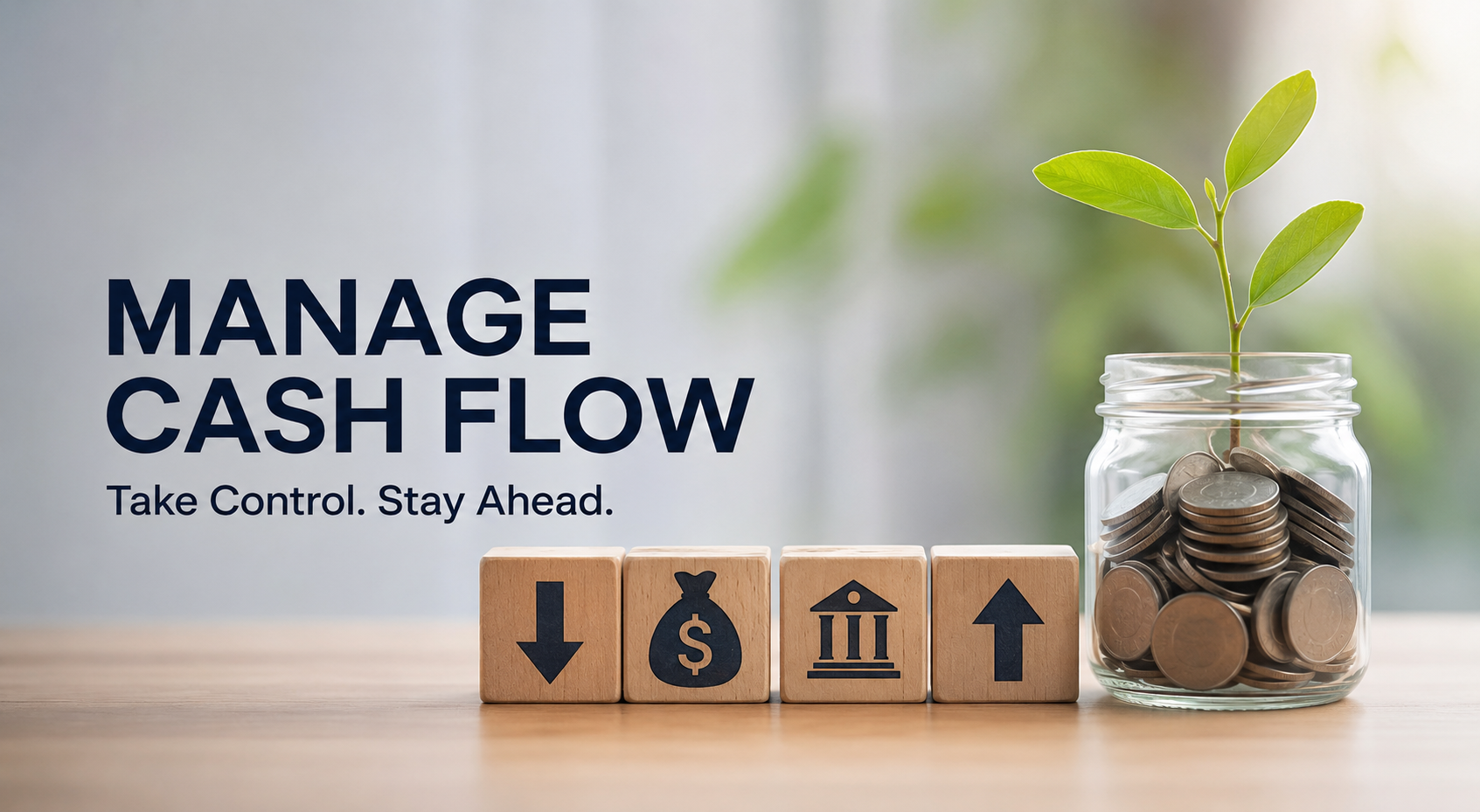



Cash flow is the lifeblood of any business or household. You can be profitable on paper and still go broke. You can have a complete order book and still miss payroll. The moment you stop noticing money moving in and out — the timing, the gaps, the surprises — it begins running you instead of the other way around. Here’s how to take back management.
Understand What Cash Flow Actually Means
Cash flow is not profit. This distinction trips up even experienced entrepreneurs. Profit is an accounting concept — income minus expenses. Cash flow is the real-time movement of actual money: what’s hitting your account today versus what’s leaving it tomorrow.
A business can indicate healthy profit margins while sitting on unpaid invoices, carrying inventory that won’t sell for 60 days, or waiting on a customer who pays quarterly. That gap between earning and getting is where businesses quietly die. Recognizing this distinction is the first and most essential step.
Build a Cash Flow Forecast — and Actually Use It
Most individuals avoid forecasting because it feels uncertain. But an imperfect forecast is infinitely more beneficial than none at all. Start with a simple 13-week rolling cash flow projection. List every expected income source by date — not when you invoice, but when you expect to receive payment. Then list every outgoing payment by its actual due date: rent, salaries, supplier invoices, loan remittances, taxes.
The gaps that appear in this model are your danger zones. Noticing them 6 weeks out gives you options. Seeing them 6 days out gives you panic. Update the forecast weekly. It will sharpen over the period as your estimates get closer to reality.

Tighten Your Receivables Without Losing Clients
If clients are paying you in 60 days and you’re paying your suppliers in 30, you’re funding their business with your own money. Fix this systematically:
Invoice immediately:
- The moment a product ships or a service is delivered, not at month’s end.
Shorten remittance terms:
- Move from Net 60 to Net 30, or offer a 1–2% early remittance discount for clients who pay within 10 days.
Chase politely but persistently:
- Set automated reminders at 7 days before due, on the due date, and 3 days after. Most late payments are simply forgotten, not malicious.
Ask for deposits:
- project-based work, a 30–50% upfront deposit dramatically changes your cash position.
None of these requires confrontation. Frame them as a standard process, and most clients will follow along.
Stretch Your Payables — Ethically
On the other side of the ledger, don’t pay before you have to. If a supplier offers Net 30, use Net 30. If you can negotiate Net 45 or Net 60 on larger purchases, do it. This is not about being difficult — it’s about matching your cash outflows to your cash inflows as closely as possible.
Build strong vendor relationships so that when you do need flexibility, goodwill already exists. One honest conversation during a tight month is far better than a missed payment with no warning.
Create a Cash Reserve — Even a Small One
A cash buffer is not a luxury. It’s infrastructure. Even one to three months of operating expenses sitting in a separate account changes how you make decisions. You stop accepting bad clients out of desperation. You stop avoiding necessary investments because the timing feels risky. You stop losing sleep over a slow week.
Start with a small, automatic transfer — even 3–5% of every remittance received — into a dedicated reserve account. Don’t touch it for operational expenses. Treat it like a utility bill. Build it slowly, and it will transform your relationship with financial uncertainty.
Know Your Cash Flow Killers
A few patterns destroy cash flow more than anything else:
Rapid growth without planning:
- Scaling too fast means hiring, buying, and spending before the new income arrives. Growth can kill a business.
Seasonal blindness:
- If your income is seasonal, your expenditures often aren’t. Map your lean months in advance and build reserves during peaks.
Over-reliance on one client:
- When 60% of your income comes from one source, their payment behavior controls your entire operation.
Ignored tax obligations:
- VAT, income tax, payroll taxes — these create large, predictable outflows that too many business owners treat as surprises. Set aside a percentage of every payment specifically for tax, in a separate account, from day one.

Use the Right Tools and Get Expert Eyes
You don’t required to handle cash flow alone or manually. Accounting software like QuickBooks, Xero, or Wave gives you real-time visibility. Many now involve cash flow dashboards and forecasting built in. Use them. A good accountant or bookkeeper — even part-time — pays for themselves in the decisions they inform and the disasters they prevent. They notice patterns you’re too close to notice.
Conclusion
Controlling cash flow is not a finance skill — it’s a survival skill. And like any skill, it sharpens with practice. Begin today, stay consistent, and the numbers will start working for you instead of against you.
Cash flow issues rarely appear without warning; they build slowly through small habits and ignored signals. The businesses and individuals who thrive financially are not the ones who earn the most. They are the ones who notice clearly, plan persistently, and never let the gap between earning and getting become someone else’s opportunity.
FAQ’s
What’s the difference between cash flow and profit?
Profit is income minus expenditures on paper. Cash circulation is the actual timing of money entering and leaving your account. You can be profitable and cash-poor if clients pay late.
How often should I check out my cash flow?
Weekly is ideal for businesses. Monthly is the minimum, daily during tight periods or rapid growth phases.
What is a good cash reserve to maintain?
Aim for 1–3 months of operating expenses. Start smaller if needed, but start immediately and build consistently. Pay employees and critical suppliers first. Communicate proactively with others. Chase outstanding invoices aggressively.
Should I use a line of credit for cash flow?
A revolving credit line can effectively bridge short-term gaps. Use it for timing mismatches, not ongoing losses. Borrowing to cover structural deficits makes the issues worse.
How do I enhance cash flow without cutting prices dramatically?
Focus on receivables first — faster collection has an immediate impact. Then look at remittance terms with suppliers. Cost-cutting is often the last resort, not the first.