







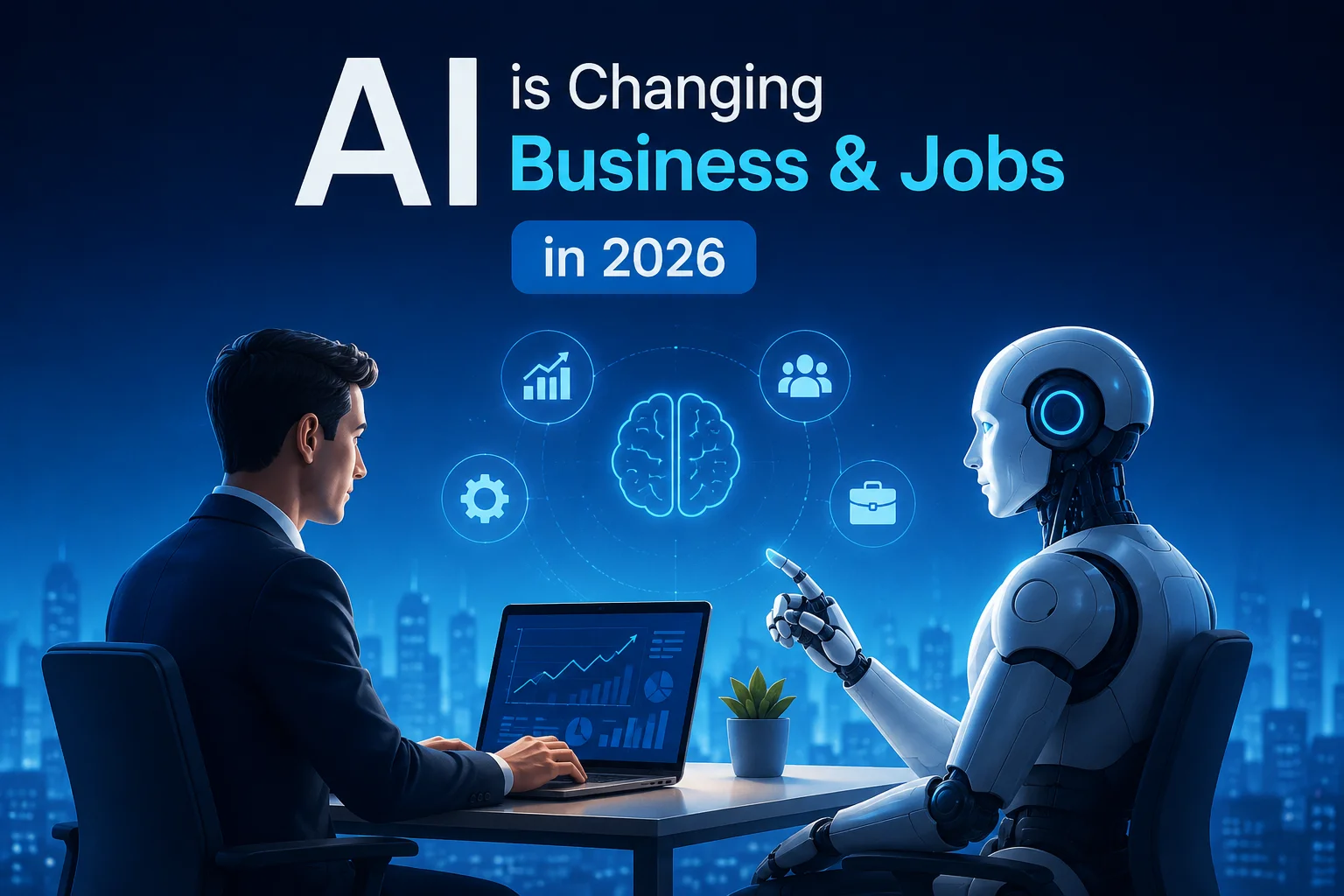
AI is changing business in 2026 by automating routine tasks, speeding up customer service and helping companies analyze data faster, and it is changing jobs by reshaping tasks more than replacing whole roles. The World Economic Forum’s Future of Jobs Report 2025 projects that by 2030 technology trends, including AI, will help create about 170 million jobs and displace about 92 million, a net gain of about 78 million. Adoption is still uneven: US Census Bureau surveys found that between 17% and 20% of US businesses used AI in early to mid 2026. This guide explains where AI is used, which jobs are changing and how workers and businesses can prepare.
What Is Artificial Intelligence?
Artificial intelligence (AI) is technology that performs tasks that usually need human thinking, such as understanding language, recognizing images and spotting patterns. Unlike traditional software, which follows fixed rules written by programmers, many AI systems learn from data, so they improve as they are trained on more examples. Today, AI can:
- Answer customer questions through chatbots.
- Draft emails, reports and articles.
- Translate languages.
- Recognize and generate images.
- Analyze large amounts of data and flag unusual patterns.
Why Are Companies Using AI?
Companies use AI mainly to save time, cut costs and serve customers faster. The most common reasons are:
- Automating repetitive tasks such as data entry and scheduling.
- Providing 24/7 customer support.
- Reducing errors in routine work.
- Understanding customer behavior from data.
- Freeing staff to focus on higher-value work.
A Census Bureau survey found that businesses using AI apply it most often to marketing and sales, strategy and IT. Our top US business trends for 2026 covers the latest adoption data.
How Is AI Used Across Industries Today?
| Industry | How AI is used |
|---|---|
| Customer service | Chatbots, order tracking, appointment booking, call summaries |
| Healthcare | Analyzing medical images, managing records, scheduling, medication reminders |
| Education | Tutoring support, lesson planning, grading assistance |
| Manufacturing | Robotics, quality inspection, predictive maintenance |
| Banking and finance | Fraud detection, credit checks, customer support |
| Transportation and logistics | Route planning, fuel savings, delivery tracking, driver safety alerts |
| Agriculture | Weather and soil analysis, crop monitoring, irrigation planning |
| Marketing | Content drafts, ad targeting, customer segmentation |
In healthcare, AI supports doctors rather than replacing their judgment, and in banking it helps flag suspicious transactions so humans can review them. In every industry, human oversight remains important because AI can make mistakes.
How Is AI Changing Jobs?
AI is changing jobs in three ways at once: automating some tasks, creating new roles and changing the skills existing roles require.
- Tasks being automated: routine, repetitive work such as data entry, basic customer queries, simple document processing and scheduling.
- Roles growing: AI and machine learning specialists, data analysts, cybersecurity experts, software developers and people who can combine AI with skills such as marketing, design or operations.
- Skills changing: the World Economic Forum expects about 39% of workers’ core skills to change by 2030, with AI and big data, cybersecurity and technological literacy growing fastest, alongside creative thinking, resilience and flexibility.
For most workers, the near-term change is that AI takes over parts of a job, not the whole job. People who learn to use AI tools well tend to become more productive and more valuable.
What Are the Benefits of AI for Businesses?
- Higher productivity: tasks are completed faster.
- Better decisions: AI can analyze large data sets and highlight risks and trends.
- Lower costs: automation reduces time spent on routine work.
- Faster customer service: customers get answers at any time.
- Fewer routine errors: when systems are well set up and checked.
What Are the Challenges of Using AI?
- Job changes: workers need training to adapt to new tasks.
- Privacy: customer data must be handled carefully and legally.
- Security: AI systems must be protected from misuse and attacks.
- Accuracy and bias: AI can produce confident but wrong answers or reflect bias in its training data, so humans must review important outputs.
- Cost and skills gaps: smaller businesses may lack the budget or expertise to adopt AI well.
How Can Workers and Businesses Prepare?
- Learn to use common AI tools in your current role, starting with one task.
- Build skills AI cannot easily replace, such as communication, judgment, creativity and relationship-building.
- For businesses, start with one measurable use case, such as answering common customer questions, then expand.
- Set clear rules for checking AI output and protecting data.
- Train staff rather than simply replacing them, because experienced people plus AI often outperform either alone.
For practical tools, see our guide to AI tools transforming small businesses, and for career ideas, the best online skills to learn in 2026.
Conclusion
In 2026, AI is changing how businesses operate and how people work. It helps companies save time, cut costs, improve service and make better decisions, while shifting the skills workers need. Some tasks are disappearing, but many new roles are emerging, and global forecasts point to more jobs created than lost by 2030. The future is not about competing with AI but about learning to work alongside it.
Frequently Asked Questions
Will AI take my job?
For most people, AI is more likely to change parts of their job than replace it entirely. Routine tasks are most at risk, so learning to use AI tools and building human skills is the best protection.
Which jobs are growing because of AI?
Roles in AI and machine learning, data analysis, cybersecurity and software development are growing fastest, along with jobs that combine AI skills with marketing, design or operations.
How many businesses use AI?
US Census Bureau surveys found that between 17% and 20% of US businesses used AI between December 2025 and May 2026, with larger firms more likely to use it.