








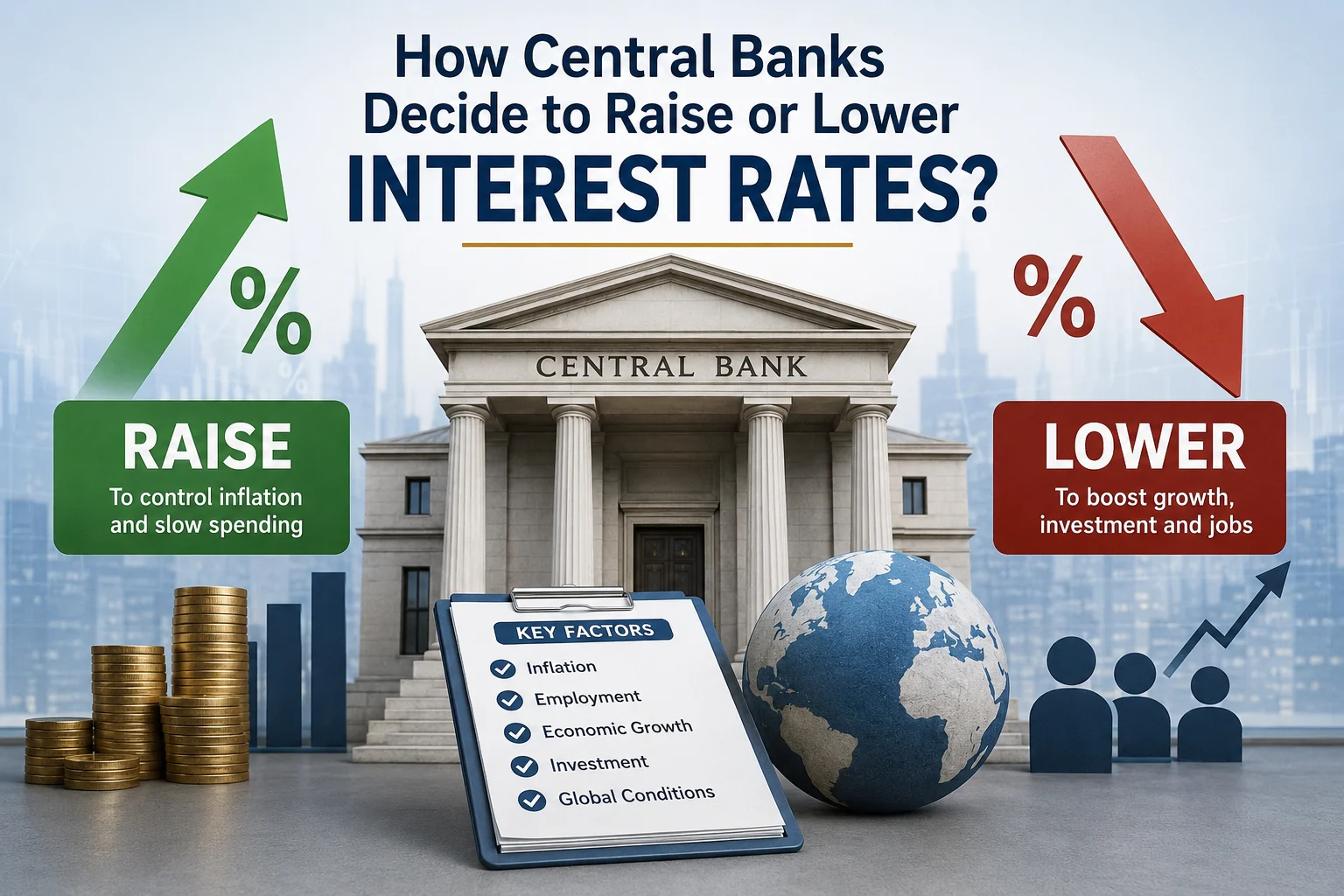
Interest rates influence nearly every part of the economy. They affect how many people pay on home, car, and business loans. They also influence investments, costs, and jobs. The institutions that handle interest rates in a country are known as the central bank. Every country has its own central bank, like
- In America, there is the Federal Reserve.
- In the United Kingdom, there is the Bank of England.
- There is the European Central Bank in Europe.
The major function of a central bank is to fix the interest rate. They decide whether interest rates should be increased, decreased, or kept the same.
This article will give you a simple guide about the functioning of a central bank and what is the importance of interest rates.
The Central Bank
A central bank is the major financial organization of a country. It helps to keep the economy strong and stable.
The major functions of a central bank include,
- Fixing interest rates.
- Controlling inflation.
- Improving economic growth.
- Protecting the banking system.
- Managing the money supply.
Like normal banks, the central bank does not meet the needs of everyday customers. It works with the private banks and the government.
Interest Rate
An interest rate is the charge for borrowing money. In simple words, if you take a loan from a bank, you have to pay back the amount you take with additional money, which is called interest.
For Example:
If you take a loan from a bank of $2,000 and the interest rate is 5%. You have to pay back $2,100 after one year.
If you deposit your money in your savings account, the bank will pay your money back with interest for keeping your money there.

What Is The Importance Of Interest Rates?
Interest rates influence many parts of the economy. It effects,
- Property loans.
- Vehicle loans.
- Educational loans.
- Company loans.
- Investment.
- Costs of goods.
- Savings accounts.
- Credit cards.
Even a minor change in the interest rates has a huge effect on the overall economy.
Why Do Central Banks Change Interest Rates?
Central banks do not change interest rates without any reason. They have three major objectives, which are,
- Keeping prices balanced.
- Provide jobs.
- Support the growth of the economy.
Sometimes, these objectives work closely together, and sometimes they don’t. Therefore, central banks slowly study the economy before taking a decision.
Inflation
Inflation means the price of goods increases over time.
For Example:
Last year the price of bread was $2, and now it is $2.20. This price has increased due to inflation. Minor inflation is normal, but high inflation can cause many issues.
Why High Inflation Is a Problem?
When inflation becomes too high. It causes several issues, which include,
- Food items become expensive.
- Property rent increases.
- Fuel becomes expensive.
- Electricity bills increase.
- Decrease peoples purchasing power.
Therefore, central banks try their best to keep the inflation level moderate.
Which Information Do Central Banks Study?
Before changing interest rates, central banks have to study some points carefully. They do not make decisions irresponsibly. They review the facts and information before making a decision.
The major things to study before changing interest rates include,
Inflation
Inflation is the major factor. If inflation is too high, higher interest rates are required, while if inflation is low, lower interest rates are better.
Employment
Central banks check employment carefully. They ask different questions
- How many people are employed?
- Are companies hiring new staff?
- Is unemployment increasing with time?
A good job market mostly helps the economy id going better.
Economic Growth
Economic growth tells how much the country’s economy is growing. If economic growth is too slow, a lower interest rate may motivate more investments. If economic growth is fast and increasing inflation, high interest rates are better.
Business Investment
Businesses usually take loans to build industries, purchase machines, and hire new workers. If the companies are investing little, the central bank may decrease interest rates to motivate more investment.
Worldwide Economy
Countries trade with each other everyday. Issues in one country can influence the other ones. Central banks also review international trade, exchange rates, political changes, and oil prices. These factors can affect inflation and economic growth also.

Conclusion
Central banks play a very important role in every country’s economy. One of their biggest responsibilities is deciding whether to raise, lower, or keep interest rates the same. They make these decisions by carefully studying inflation, employment, economic growth, consumer spending, business investment, and conditions around the world.
When inflation becomes too high, central banks usually raise interest rates to slow spending and reduce price increases. When the economy becomes weak, they often lower interest rates to encourage borrowing, spending, investment, and job creation.
For more expert insights on finance, business, and global economic trends, visit Market Business Magazine.
FAQ’s
1. What is a central bank?
A central bank is the main financial institution that manages a country’s money supply, controls interest rates, and works to keep the economy stable.
2. Why do central banks raise interest rates?
They raise interest rates to reduce inflation by making borrowing more expensive and slowing spending.
3. Why do central banks lower interest rates?
They lower interest rates to encourage borrowing, spending, business investment, and economic growth.
4. How do higher interest rates affect loans?
Higher interest rates usually make home loans, car loans, business loans, and credit cards more expensive.
5. How do lower interest rates help the economy?
Lower interest rates make borrowing cheaper, encourage spending and investment, and can help create more jobs.