








Daily, people and companies exchange the money of one country with another. If you travel to a foreign country, purchase different items from foreign countries, or send money to your family abroad, you will have to use a currency exchange rate. These rates change continuously. Sometimes there is a small change, and sometimes there are huge changes. Most people wonder why one currency becomes more effective while others are less effective. This is because exchange currency depends on various factors.
This article will guide you on how currency exchange rates work and the reasons for these changes.
Currency Exchange Rate
A currency exchange rate is the worth of one currency against another. The exchange rate indicates how much one currency is worth when you exchange it with another one. If the currency rate changes tomorrow, you will get more or less money than you receive today.
For Example:
1 USD = 280 PKR.
1 USD = 0.90 EUR.
Why Does Every Country Have Its Own Currency?
Every country has different currencies, like
- America uses the US dollar (USD)
- Japan uses Japanese Yen.
- Pakistan uses the Pakistani Rupee (PKR)
- India uses the Indian Rupee.
- UK uses the British Pound.
Since each country uses its own currency, exchange rates are needed when people travel, trade, or send money to their families abroad.
What Decides Exchange Rates?
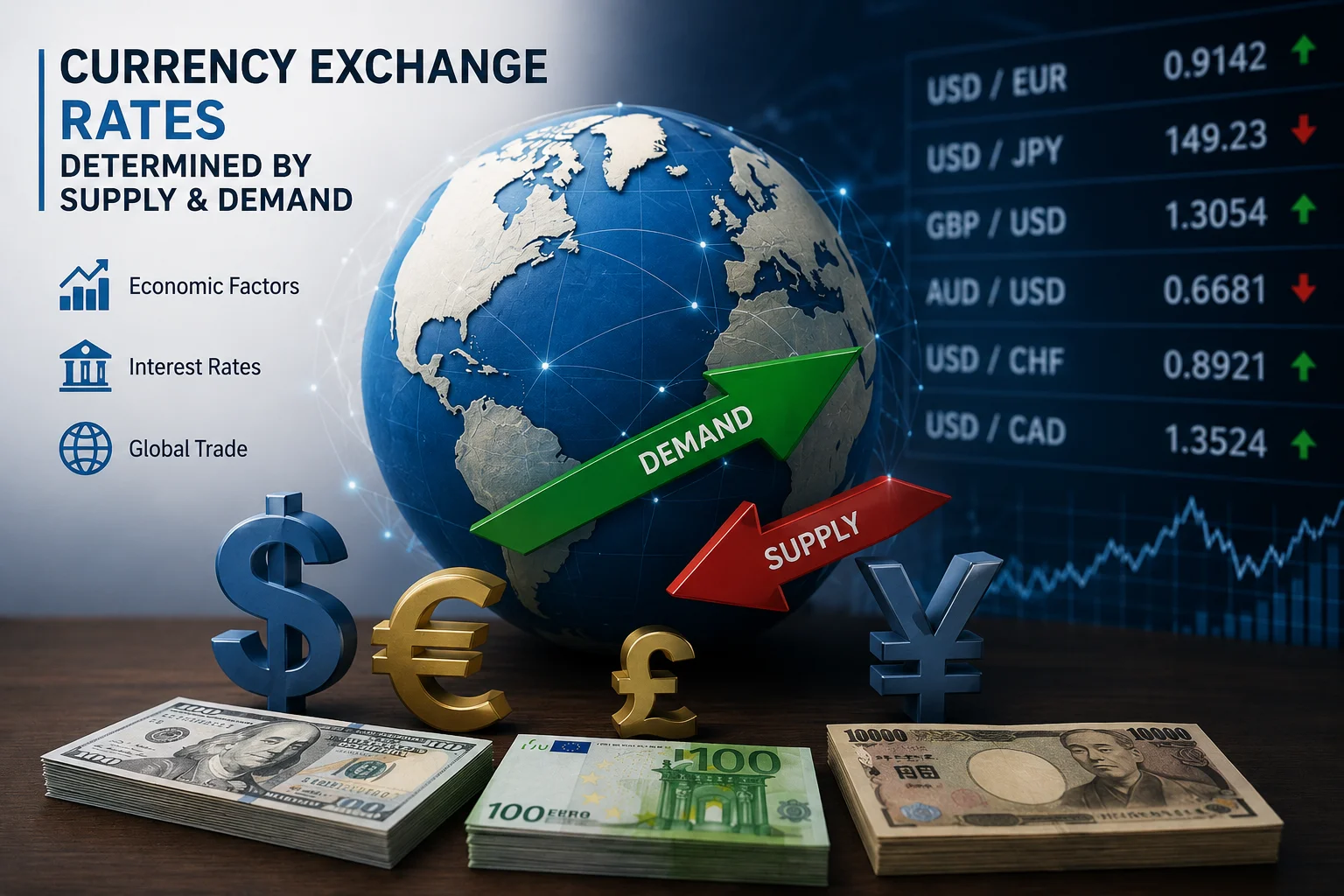
Exchange rates are controlled by supply and demand. In the same way as the price of any item, the value of the currency changes according to the number of people who want to buy it and sell it.
If more people want a currency, its worth will rise, while if few people want it, its value decreases.
Supply And Demand
Imagine that most companies in the whole world want to purchase products from the US. Before paying the US, they need US dollars. So, when more people buy US dollars, its value increases, and when the demand for US dollars decreases, its value falls. This is how supply and demand change the exchange rates every day.
Why People Purchase Foreign Currencies?
People purchase foreign currency for several reasons. The following are some basic activities which rise the demand for the currency:
- Some people buy it when they move to another country.
- Companies buy it when they purchase products from abroad.
- Businesses use it for investment in different countries.
- Families send money to their relatives who live in a foreign country.
- Travelers use money when they visit another country.
How Do Different Factors Affect Currency Exchange Rates?
The following are some basic factors which affacts the currency exchange rates:
International Trade
Trading is the major reason for change in the value of currency. Different countries buy and sell different currencies daily.
For Example
Germany sells cars to different countries. The company who are purchasing those cars need Euros to pay. As more Buyers buy Euros, their value increases and the currency becomes stronger.
Excessive Imports
Imports are the items that a country purchases from other countries. If a country imports a lot of items, companies will exchange their local currency for foreign currencies, which increases the demand for the foreign currency.
Therefore, the local currency becomes weaker if the imports are higher.
Interest Rate Affects
Interest rate is another major factor. Interest rates are fixed by the country’s central bank. When the interest rate becomes higher, investors may earn more profit by keeping the money inside the country. When more investors buy the country’s currency, its value increases.
On the other hand, if the interest rate is low, investors may use their money in other countries, which falls the demand for the country’s currency and it becomes weaker
Central Bank
The central bank is the key bank of the country. It handles the country’s finances. The major functions of central banks include,
- Fixing interest rates.
- Managing inflation.
- Handling the money supply.
- Keeping finances stable.
- Sometimes also exchange currencies.
Therefore, central banks play an important role in affecting exchange rates.
Inflation
Inflation means that the price of goods increases with time. When inflation decreases, the value of money is stronger. Citizens and investors have great confidence in that currency. But if inflation increases, the purchasing power may decrease, and people lose confidence in their currency.
Economic Growth
Strong economies get more investments. Companies like to invest in countries whose economy is strong and growing over time. Investors have to purchase the country’s currency before investing. More investments mean that the demand for currency increases, which improves its value.
Political Instability
Investors search for countries with stable governments before investing. Political stability boosts the confidence of the investors. They feel secure before investing money. Therefore, political stability is very important to increase the demand for the country’s currency.
Oil Prices
Oil prices can also influence currencies. Countries that export oil receive more foreign revenue when oil prices rise. More purchasers need their currency to export oil. This increases the demand for the currency, and it becomes stronger, while those countries that import a huge amount of oil will spend a lot of foreign currency, which results in weakening their own country’s currency.
Natural Disasters
Unexpected disasters and conflicts also affect exchange rates. Natural disasters, like
- Earthquakes.
- Floods.
- Conflicts.
- Severe situations.
All these events reduce business activities. Therefore, investors move their money to secure places, which changes the exchange rates quickly.
Conclusion
Currency exchange rates are determined mainly by supply and demand. When more people want a currency, its value usually rises. When fewer people want it, its value usually falls. However, many other factors also influence exchange rates, including interest rates, inflation, economic growth, international trade, political stability, foreign investment, government policies, and global events.
For more expert insights on business, finance, and global market trends, visit Market Business Magazine.
FAQ’s
What is a currency exchange rate?
The worth of one country’s currency as compared to another one is called a currency exchange rate. When more people buy the currency of any country for some specific purpose, its demand increases, and the value of the currency becomes strong, while if fewer people buy that currency, its value will fall.
What are the major reasons for changes in exchange rates?
The major reasons for changes in currency exchange rates are interest rates, inflation, trade, political stability, and economic growth.
What raises the value of the currency?
A currency of any country becomes stronger when its demand increases, the economy grows smoothly, interest rates are higher, and investors have confidence to spend money in your country.