





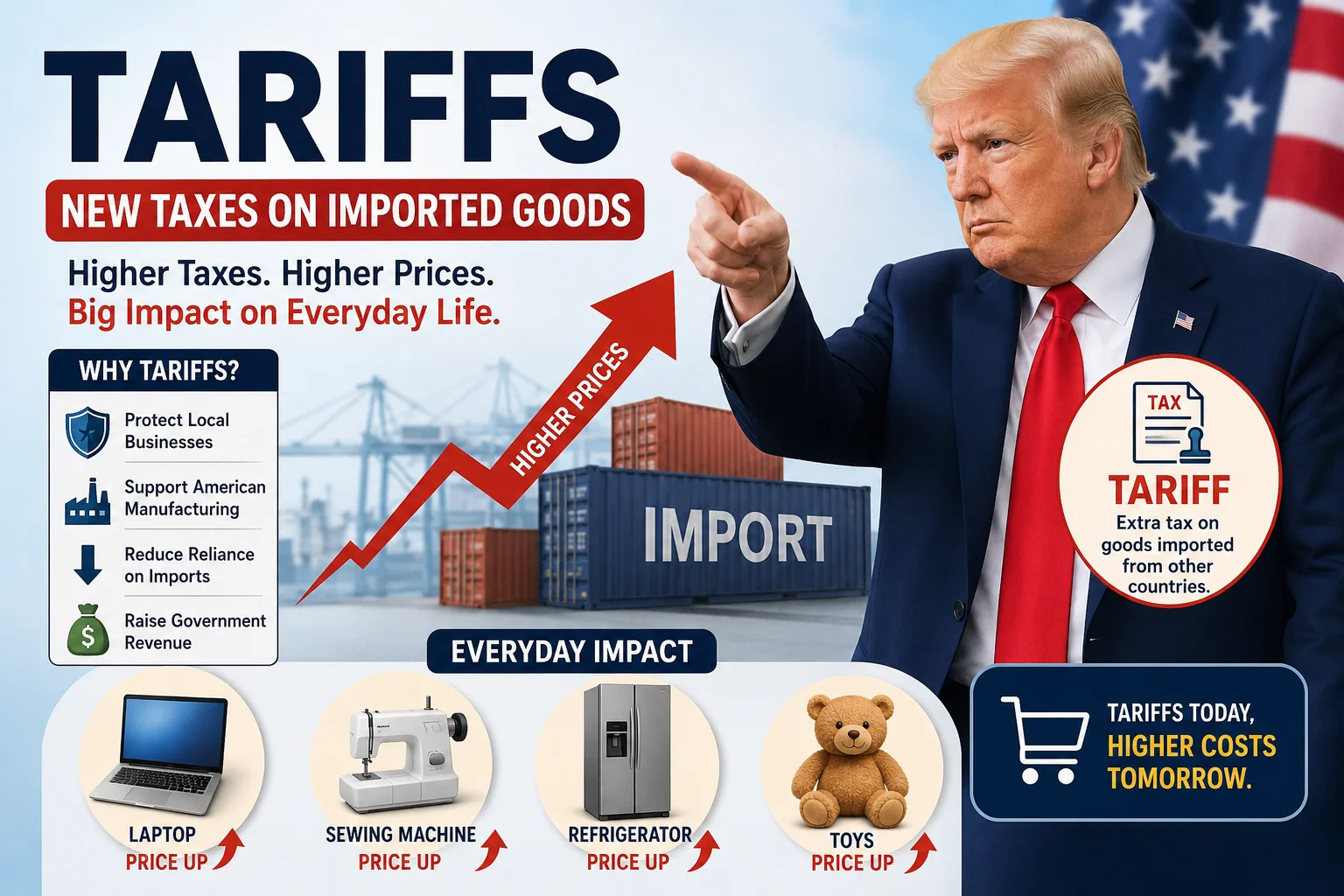
Tariffs are taxes on imported goods, paid by the importing business when products enter the United States. In 2026, US tariff policy changed 3 times: the Supreme Court struck down President Donald Trump’s emergency tariffs in February, a temporary global tariff replaced them for 150 days, and new Section 301 tariffs of 10% or 12.5% on goods from 60 economies took over on July 24, 2026. This explainer covers how tariffs work, what happened in 2026, who pays and how the changes affect prices and businesses.
What Is a Tariff?
A tariff is a tax charged on goods imported from another country, usually calculated as a percentage of the product’s value. A 10% tariff on a $1,000 shipment of machine parts adds $100 in duty. US Customs and Border Protection (CBP) collects the duty from the importer of record, which is normally a US business, not the foreign exporter.
Governments use tariffs for 4 main purposes:
- Protecting domestic industries from foreign competition.
- Gaining leverage in trade negotiations.
- Responding to practices they consider unfair, such as subsidies or forced labor.
- Raising government revenue.
Who Actually Pays for Tariffs?
US importers pay tariffs directly, and research shows that most of the cost usually passes on to US businesses and consumers. Studies of the 2018 to 2019 US tariffs, including work by Mary Amiti, Stephen Redding and David Weinstein published in the Journal of Economic Perspectives in 2019, found that almost the entire cost of those tariffs fell on US buyers through higher prices. Some exporters lower their prices to stay competitive, which shares part of the cost.
What Happened to Trump’s Tariffs in 2026?
The legal basis for most of Trump’s broad tariffs changed during 2026, but overall tariff levels stayed elevated.
| Date | Change |
|---|---|
| April 2025 | Broad “reciprocal” tariffs announced under the International Emergency Economic Powers Act (IEEPA). |
| November 5, 2025 | The Supreme Court heard arguments on whether IEEPA allows tariffs. |
| February 20, 2026 | The Supreme Court ruled 6 to 3 in Learning Resources, Inc. v. Trump that IEEPA does not authorise the president to impose tariffs. |
| February 24, 2026 | A temporary 10% global import surcharge took effect under Section 122 of the Trade Act of 1974, which allows such tariffs for up to 150 days. The administration also announced plans to raise the rate to 15%. |
| July 24, 2026 | The Section 122 surcharge expired after Congress did not extend it. New Section 301 tariffs of 10% or 12.5% on goods from 60 economies took effect the same day. |
What Are the New Section 301 Tariffs?
The new Section 301 tariffs are duties of 10% or 12.5% on goods from 60 economies, including China and the European Union, that together supply more than 99% of US imports. The Office of the US Trade Representative (USTR) based them on investigations finding that these economies failed to prohibit or enforce bans on imports made with forced labor.
3 differences from the earlier tariffs matter for businesses:
- No fixed end date: unlike Section 122, Section 301 tariffs have no automatic expiry.
- Different rates by origin: some goods stay at 10%, others move to 12.5%, and some fall under exclusions.
- Legal challenges: the Liberty Justice Center filed a challenge to the new duties shortly after they took effect.
Which Tariffs Were Not Affected by the Supreme Court Ruling?
Tariffs imposed under other laws stayed in force after the ruling. These include Section 232 tariffs on national security grounds, covering steel, aluminum, automobiles and copper, and earlier Section 301 tariffs on many goods from China.
What Happens to Tariffs Already Paid Under IEEPA?
The Supreme Court did not rule on refunds, so the process for recovering IEEPA tariffs already paid remained unclear after the decision. Analysts estimated that importers had paid well over $100 billion under the struck-down tariffs. Businesses that paid these duties are tracking guidance from CBP and the courts.
How Do Tariffs Affect Prices and Businesses?
Tariffs raise costs for imported goods and for products made with imported parts. 5 common effects:
- Higher prices for consumers on affected goods.
- Higher input costs for manufacturers that import components.
- Retaliatory tariffs from trading partners, which can hurt US exporters.
- Changes to supply chains as companies shift production to other countries.
- Uncertainty that delays business investment decisions.
Read more on how global supply chains actually work and how stock markets react to political events.
What Do Supporters and Critics Say?
Supporters argue that tariffs protect American manufacturing jobs, reduce dependence on foreign suppliers, pressure trading partners to change unfair practices and raise federal revenue. Critics, including many economists and business groups, argue that tariffs act as a tax on US consumers and businesses, invite retaliation and raise costs for manufacturers that depend on imported parts. The Supreme Court case itself concerned which law gives the president tariff power, not whether tariffs are good policy.
How Can Businesses Prepare for Tariff Changes?
- Confirm the country of origin and tariff classification for every imported product.
- Update landed-cost calculations for the new Section 301 rates.
- Check whether goods qualify for exemptions, such as USMCA-qualifying goods from Canada and Mexico.
- Review supplier contracts for clauses on who pays duties.
- Work with a licensed customs broker and follow CBP and USTR updates.
Frequently Asked Questions
Did the Supreme Court end Trump’s tariffs?
The Supreme Court struck down tariffs imposed under IEEPA on February 20, 2026, but the administration replaced them with tariffs under other laws.
What is the current US tariff on most imports?
Since July 24, 2026, most imports from the 60 covered economies face new Section 301 tariffs of 10% or 12.5%, in addition to any Section 232 or earlier tariffs that apply.
Who pays a tariff?
The US importer pays the tariff to Customs, and much of the cost is usually passed on to customers.
Can tariff rates change again?
Yes. Tariff policy is subject to new investigations, trade deals, court rulings and congressional action.
Sources
- Supreme Court of the United States. Learning Resources, Inc. v. Trump, decided February 20, 2026.
- Office of the United States Trade Representative. Section 301 action on forced labor, July 2026.
- Trade law firm analyses from Cleary Gottlieb, National Law Review and Mondaq, July and August 2026.
- Amiti M, Redding SJ, Weinstein DE. The Impact of the 2018 Tariffs on Prices and Welfare. Journal of Economic Perspectives, 2019.
This article was last updated on November 5, 2026, and is for general information only. It is not legal or customs advice. Tariff rules change frequently.