







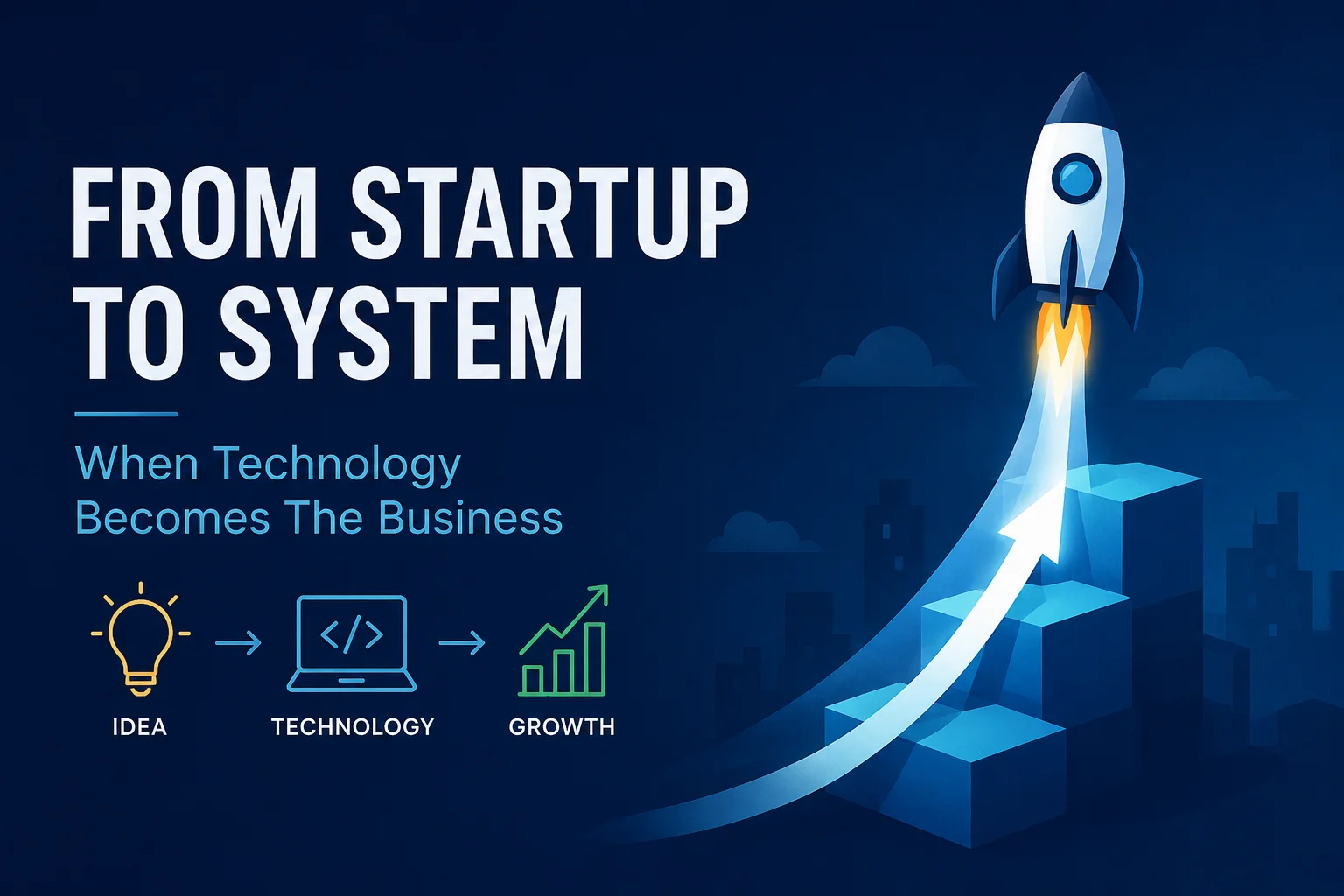
Technology becomes the business when the software, data and platform a company builds are what customers actually pay for, rather than tools that simply support another product. A traditional shop uses software to track stock; a marketplace app is the software. Most such companies follow the same path: they solve one narrow problem with a simple digital tool, turn it into a platform, use data to improve it, automate the work behind it and then scale to customers far beyond their home market. This guide explains that journey stage by stage, why technology-first companies grow differently and what can go wrong.
Last updated: November 2026.
What Is the Difference Between Tech-Enabled and Tech-First Businesses?
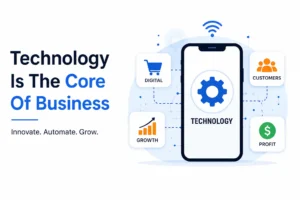
A tech-enabled business uses technology to deliver something else, while a tech-first business sells the technology itself or the service it makes possible.
| Feature | Tech-enabled business | Tech-first business |
|---|---|---|
| What customers buy | A physical product or in-person service | Software, a digital service or access to a platform |
| Role of technology | Supports operations: accounting, stock, booking | Is the product and the main source of value |
| Cost of serving one more customer | Rises with each sale (stock, staff, space) | Often very low once the software exists |
| How it grows | New locations, more staff | More users on the same system |
| Examples | Restaurant, clinic, retail shop, factory | Software-as-a-service, marketplace, streaming, payments app |
In traditional businesses, technology made work more efficient: computers tracked stock, banks processed transactions digitally and hospitals stored records electronically. In each case, customers were paying for something else. As software, smartphones and the internet matured, entrepreneurs realised they could build whole businesses around the technology itself.
What Changed When Technology Became the Product?
Digital platforms showed that a company could deliver huge value while owning very few physical assets. A ride-hailing app connects passengers with drivers through one interface: riders see the price in advance and track the car, while the company owns few vehicles. Its value lies in its software, data and network of users. Streaming services, online marketplaces and payment apps follow the same pattern: the technology is what customers pay for.
Why Has Technology Become the Business?
Almost Everyone Is Reachable Online
The International Telecommunication Union estimates that about 6 billion people, roughly 74% of the world’s population, used the internet in 2025, while about 2.2 billion remained offline, mostly in lower-income countries. A digital product can reach that audience without opening a single store.
Smartphones Changed Expectations
People now order food, pay bills, book travel and manage money through apps. Customers expect fast, self-service digital options, and businesses that offer them win share from those that do not.
Software Scales Cheaply
Once a software product is built, serving one more customer usually costs little: some extra hosting and support. That is very different from a restaurant, which needs more ingredients, staff and space for every extra meal. Low marginal cost is why successful software companies can grow quickly and reach high margins.
AI and Automation
AI lets companies personalise services, answer routine questions and analyse data at scale. McKinsey’s 2025 survey found 88% of organisations use AI in at least one business function. Read more in how AI is changing business and jobs in 2026.
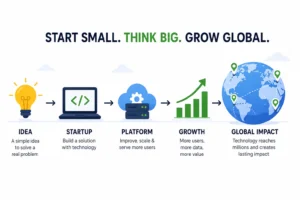
How Do Startups Become Technology Systems? The 5 Stages
| Stage | Goal | Key question |
|---|---|---|
| 1. Solve one problem | Prove a narrow group of users needs the product | Will people use it repeatedly and pay? |
| 2. Build a platform | Add features that keep users coming back | Does each new feature increase retention? |
| 3. Use data | Improve the product from real usage | Is the product getting better as more people use it? |
| 4. Automate | Serve more customers without equal cost growth | Which manual steps can software handle? |
| 5. Scale | Expand to new regions or customer groups | Can the system handle 10 times the users? |
Stage 1: Solve One Specific Problem
Successful technology companies start narrow: one problem, one type of customer. They build the simplest version that solves it, often with manual work behind the scenes, and test it with real users. Repeat use and willingness to pay matter more than sign-ups.
Stage 2: Build a Platform
Once users rely on the product, the company adds features that make it harder to leave: saved history, integrations with other tools, team accounts or a marketplace connecting two sides. Platforms that connect buyers and sellers can benefit from network effects, where each new user makes the service more useful for everyone else.
Stage 3: Gather and Use Data Responsibly
Usage data shows which features matter, where users get stuck and what they want next. Used well and within privacy laws, it turns the product into a system that improves itself. Our article on the algorithm economy explains how data-driven decisions shape modern platforms.
Stage 4: Automate the Operations
Manual steps that worked for 100 customers break at 10,000. Automating onboarding, billing, support and quality checks lets the company grow revenue faster than costs.
Stage 5: Scale Beyond the Home Market
Technology lets a company serve customers in many cities and countries without physical locations. Growth can be fast, but international expansion brings new laws, taxes, languages, payment methods and competitors.
What Are the Risks When Technology Becomes the Business?
- Security and outages: when the software is the product, a breach or downtime stops the whole business.
- Technical debt: quick early code becomes expensive to maintain as the company grows.
- Platform dependence: relying on one app store, cloud provider or search engine for most customers creates a single point of failure.
- Regulation: privacy, consumer protection and AI rules are tightening in many markets.
- Copycats: features are easy to copy, so lasting advantage usually comes from data, network effects, brand or switching costs.
Is Your Business Becoming a Technology System? A Founder Checklist
- Do customers pay mainly for your software, platform or digital service?
- Does serving one more customer cost much less than serving the last one?
- Does usage data guide your product decisions every month?
- Are onboarding, billing and support mostly automated?
- Could your system handle 10 times today’s users without 10 times the staff?
If you answer yes to 4 or 5, your company is already operating as a technology system. To judge how scalable your model is, read what makes a business scalable, and for large-company AI adoption see AI in the enterprise.
Frequently Asked Questions
What does “technology becomes the business” mean?
It means the software, platform or data is what customers pay for, rather than a tool that supports a separate product.
Why can software companies grow so fast?
Because serving extra customers usually costs little once the product is built, so revenue can grow much faster than costs.
Do small businesses need to become technology companies?
No. Most will remain tech-enabled, but using good software for sales, operations and customer service is now essential to compete.
What is a network effect?
A network effect happens when a product becomes more valuable as more people use it, such as a marketplace with more buyers and sellers.