







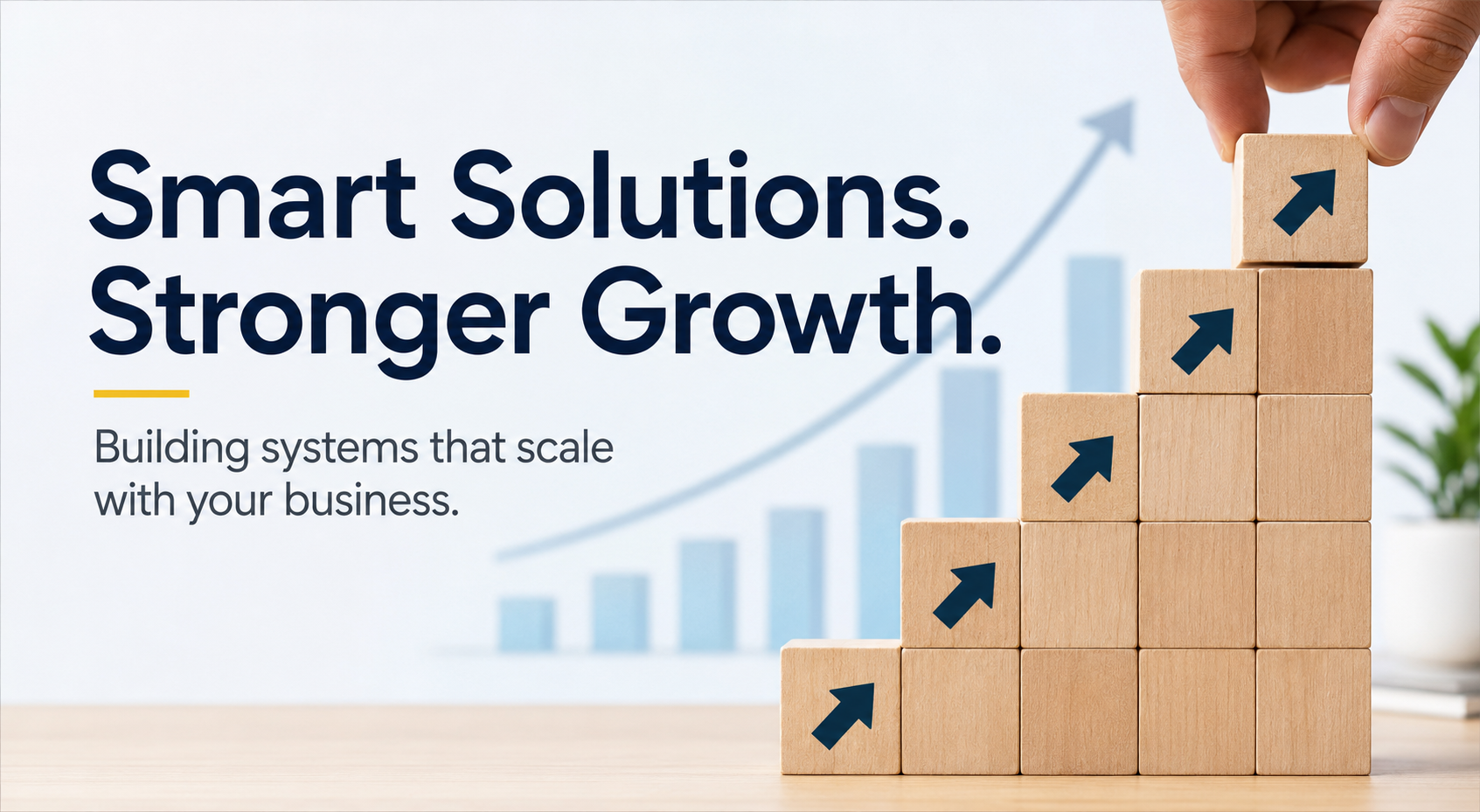
Strategies that scale with you — from first hire to market leader.
Every company hits a point where early improvisation stops working. Spreadsheets that tracked everything in year one buckle under year three. Small teams that wear every hat become bottlenecks as the business grows. Founders who closed every deal personally become the ceiling on revenue. These are signs that growth has outpaced the infrastructure beneath it. The five areas below address where growing companies either build the right foundations and accelerate, or skip them and stall.
Strengthen Your Financial Infrastructure
› Look Beyond Revenue to the Numbers That Actually Matter
Revenue is the headline, but gross margin by product line, customer acquisition cost, and lifetime value drive real decisions. Without them, pricing and hiring choices are mostly guesswork. A monthly financial review — not quarterly — turns your numbers into a navigation tool.
› Protect Cash Flow Before a Crisis Forces You To
Profitable companies go under every year because of cash timing gaps. A client pays late. A supplier demands upfront payment. A hiring push outruns billings. Maintain a sixty to ninety day operating reserve and review a rolling cash forecast weekly — the discipline that separates businesses that absorb pressure from ones that break under it.
› Hire Senior Finance Talent Earlier Than Feels Necessary
A fractional CFO costs far less than a full-time hire and delivers the financial leadership most growing companies lack until damage is already done. They design reporting structures, manage lender relationships, and flag risks before they become crises. Most say they waited too long.

Turn Sales Into a Repeatable System
› Write Down the Process Before You Hire Another Rep
Adding salespeople to an undocumented process produces proportionally more chaos. A written sales process defines every stage from first contact to close and the expected activities at each step. With it, onboarding takes weeks instead of months. Without it, every new hire invents their own approach.
› Make Your CRM the Official Record of Every Deal
A CRM that is inconsistently used is expensive software with a morale problem. Growing companies that get this right enforce one rule: if it is not in the CRM, it does not exist. No deal, no contact, no forecast. That discipline makes the revenue operation transparent and far easier to scale.
› Build a Pipeline That Does Not Depend on Referrals
Referrals carry most companies through their early years. They rarely carry them through the next phase. A lead generation engine — whether through outbound prospecting, content, paid channels, or partnerships — produces a pipeline independent of any individual’s network. It takes time to build, which is why it should start before the referrals dry up.
A sales team built on a documented process consistently outsells one built on individual talent alone.
Automate the Work That Drains Your Best People
› Start With High-Volume, Rule-Based Tasks
The best automation targets are tasks that happen frequently, follow consistent rules, and consume time from people who are expensive to replace. Invoice processing, payroll, expense approvals, and report generation all qualify. Automating them does not reduce headcount — it redirects capable people toward work that actually requires judgment.
› Connect Your Tools So Data Moves on Its Own
Most growing companies accumulate disconnected software stacks where data is manually transferred between systems. Every transfer is a potential error and a guaranteed time cost. Prioritize tools that integrate natively with your stack, and use middleware like Zapier to bridge gaps. A connected system operates faster and produces more reliable data.
› Measure Return in Time Saved, Not Just Cost
Track hours freed per week, multiply by the fully loaded cost of the people involved, and compare that to the tool’s annual price. Most automation investments pay back within six months. The exceptions are usually implementation failures, not poor tool selection.
Outsource Non-Core Work to Move Faster
› Be Honest About What Your Team Does Best
Core competency is not what your team can technically perform — it is what you do better than almost anyone and what drives your competitive edge. Everything else is a candidate for outsourcing. Legal, compliance, IT support, accounting, and HR administration are areas where dedicated vendors consistently outperform internal generalists at lower cost.
› Define What Good Looks Like Before Signing
Outsourcing fails most often not because of bad vendors but because expectations were never written down. Before any engagement, document the deliverables, performance standards, reporting cadence, and escalation path. A vendor operating against a clear standard will consistently outperform one working against vague intent. Writing it down also forces useful internal clarity about what you actually need.
› Invest in the Relationship, Not Just the Contract
Vendors who understand your business bring better ideas and flag problems earlier. Ones kept at arm’s length do the minimum required. Regular communication and honest performance feedback produce better outcomes than a transactional relationship reviewed once a quarter.

Build a Culture People Choose to Stay In
› Replace Ambiguity With Radical Clarity
The most common reason high performers leave growing companies is not pay — it is confusion. Confusion about priorities, decision rights, success criteria, and company direction. Written role definitions, clear objectives, and consistent communication from leadership address this at the source. Clarity costs nothing and returns substantial dividends in retention.
› Treat Onboarding as a Ninety-Day Investment
Most growing companies treat onboarding as a day of paperwork. The ones that structure it across thirty, sixty, and ninety days produce employees who are productive quick and remain longer. The investment is modest — a written plan, an assigned buddy, a clear first project — and reduced early attrition pays for it several times over.
› Make Compensation Transparent and Performance-Driven
Pay structures that reward tenure over results quietly destroy the meritocratic culture growing companies depend on. A transparent framework — where employees understand how pay decisions are made and what leads to advancement — builds trust, motivates the right behaviors, and makes underperformance conversations more manageable.
Companies that scale without losing their best people share one thing: they make it easy to know what winning looks like.
Build the Foundation, Then Step on the Gas
The worst decisions growing companies make are often good ideas executed too early — enterprise software before the process is stable, a sales leader before there is a repeatable motion, and outsourcing before expectations are defined. Timing matters as much as selection.
Start with the area creating the most friction today. Fix it properly. Then move to the next. That methodical approach — unglamorous as it sounds — is exactly how growing companies become enduring ones.
Conclusion
Growing a company is rarely limited by ambition — it is usually limited by systems that no longer support the pace of growth. The businesses that scale successfully are not always the ones with the biggest funding rounds or the loudest marketing. They are the ones that build operational discipline early, strengthen the areas under pressure, and create structures that continue working as complexity increases.
Financial visibility, repeatable sales systems, smart automation, strategic outsourcing, and a strong internal culture are not “corporate extras.” They are the infrastructure that allows growth to continue without breaking the business underneath it.