








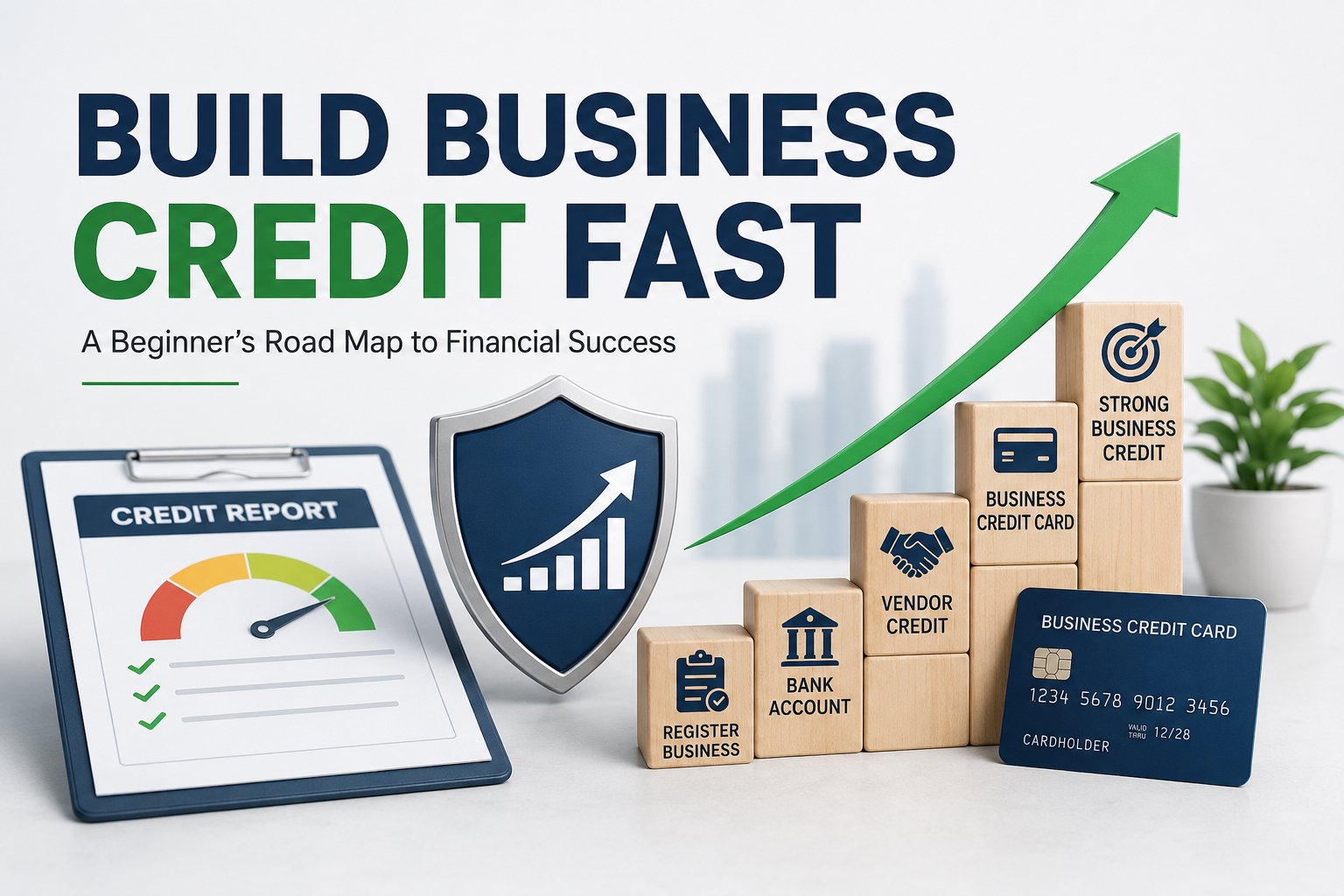
To build business credit fast, follow 8 steps: register your business as a legal entity, get a free EIN, open a business bank account, get a free D-U-N-S number, open vendor accounts that report payments, add a business credit card, pay every bill on time or early, and monitor your reports at all 3 business credit bureaus. A basic credit file can appear within a few months, and a strong profile usually takes 6 to 12 months of on-time payments. Good business credit helps you win better supplier terms, larger loans and lower rates without putting all the risk on your personal credit.
Last updated: November 2026. This guide is for US businesses.
What Is Business Credit?
Business credit is a record of how your company borrows and repays money, kept separately from your personal credit. It is tied to your business name, address and Employer Identification Number (EIN) rather than your Social Security number. 3 main bureaus collect business credit data: Dun & Bradstreet, Experian Business and Equifax Business. Lenders, suppliers, landlords and insurers check these files to decide whether to work with your company and on what terms.
Unlike personal credit, business credit files are not created automatically. Many suppliers and lenders never report to the business bureaus, so a company can pay bills for years and still have a thin or empty file. Building credit is therefore an active process: you choose accounts that report.
Why Does Business Credit Matter?
Strong business credit gives access to funding on better terms and protects your personal finances. 5 practical benefits:
- Supplier terms: net-30 or net-60 terms let you buy stock now and pay later, which eases cash flow.
- Larger loans and credit lines at lower interest rates.
- Separation of risk: fewer accounts depend only on your personal credit score.
- Credibility: large customers and government buyers often check a supplier’s business credit file.
- Lower costs: some insurers and equipment lessors price their offers using business credit data.
What Do Business Credit Scores Mean?
Each bureau uses its own scoring model, so there is no single business credit score. The table below shows the scores you will meet most often and the ranges usually seen as low risk.
| Score | Bureau | Range | Generally low risk | What it measures |
|---|---|---|---|---|
| PAYDEX | Dun & Bradstreet | 1 to 100 | 80 to 100 | How promptly you pay suppliers |
| Intelliscore Plus (original versions) | Experian | 1 to 100 | 76 to 100 | Risk of serious delinquency |
| Intelliscore Plus V3 | Experian | 300 to 850 | Higher is better | Risk of serious delinquency |
| Business Credit Risk Score | Equifax | 101 to 992 | Higher is better | Risk of severe delinquency |
| FICO SBSS | FICO | 0 to 300 | Higher is better | Blend of business and owner credit data |
A PAYDEX score of 80 indicates that a business pays on time; scores between 50 and 79 indicate moderate risk, and scores below 50 indicate high risk. Paying before the due date can lift the score above 80.
2026 update for SBA borrowers: under SBA’s SOP 50 10 8, the minimum FICO SBSS score for 7(a) small loans rose from 155 to 165 on 1 June 2025. Then, on 1 March 2026, the SBA stopped using the SBSS score for 7(a) small loan underwriting. Lenders now rely on their own credit analysis, so a clean business credit file, good bank statements and solid financials matter even more.
Step 1: Register Your Business as a Legal Entity
Form an LLC or corporation so the business exists separately from you. A sole proprietorship is legally the same person as its owner, which makes separate business credit harder to build and leaves personal assets exposed. Use the exact same legal name everywhere you apply. Our guide on how to register an LLC in the USA walks through the filing.
Step 2: Get an Employer Identification Number (EIN)
An EIN is your business’s federal tax ID, and the IRS issues it free. You can apply online on the IRS website and usually receive the number straight away. Avoid third-party sites that charge a fee for this free service. Bureaus and lenders use the EIN to identify your company.
Step 3: Open a Business Bank Account
Run all business income and spending through a dedicated business account. It creates a clear financial history, simplifies tax filing and shows lenders that the company is separate from your household. Many lenders ask for 3 to 12 months of business bank statements, so the sooner the account is open, the better.
Step 4: Get a Free D-U-N-S Number
A D-U-N-S number is a free 9-digit identifier from Dun & Bradstreet that opens your business credit file there. Many suppliers, large corporations and government agencies ask for it. Request it directly from Dun & Bradstreet; the standard number is free, although paid options promise faster processing.
Step 5: Open Vendor Accounts That Report Payments
Net-30 vendor accounts are often the easiest way to create your first business credit entries, known as tradelines. These suppliers let you buy now and pay within 30 days, then report your payment history to one or more bureaus. Before opening an account, ask 2 questions: which bureaus do you report to, and how often?
Good practice:
- Open 3 to 5 reporting accounts for things you genuinely need, such as office supplies, shipping or packaging.
- Make small purchases and pay them early.
- Avoid paying large membership fees for accounts whose only purpose is reporting.
Step 6: Add a Business Credit Card
A business credit card adds a revolving tradeline and makes monthly spending easy to track. Use it for regular costs, keep the balance well below the limit and pay the statement in full. Check the terms carefully: most small-business cards require a personal guarantee, and some issuers report to personal credit bureaus as well as business ones.
Step 7: Pay Every Bill On Time or Early
Payment history is the single most important factor in business credit scores. Set up automatic payments or calendar reminders a few days before each due date. One late payment to a reporting vendor can stay in your file for years, while consistent early payment steadily lifts scores such as PAYDEX. Good cash management makes this easier; see how to manage cash flow before it manages you.
Step 8: Monitor Your Business Credit Reports
Check your files at Dun & Bradstreet, Experian and Equifax regularly and dispute any errors. Common mistakes include wrong business names, old addresses, accounts that belong to a different company and late payments that were actually on time. Unlike personal credit, there is no federal rule giving businesses a free annual report, but each bureau offers free or low-cost ways to see your file, and correcting errors early protects future applications.
How Long Does It Take to Build Business Credit?
| Timeline | Milestone |
|---|---|
| Week 1 | Register the entity, get an EIN, open a business bank account |
| Weeks 2 to 4 | Request a D-U-N-S number, open 2 to 3 reporting net-30 accounts |
| Months 2 to 3 | First payments appear on your file; add a business credit card |
| Months 4 to 6 | Several tradelines with on-time history; scores begin to form |
| Months 6 to 12 | Established profile; apply for larger credit lines or loans |
Timelines vary because each vendor reports on its own schedule and each bureau needs a minimum amount of data before it can calculate a score.
What Mistakes Hurt Business Credit?
- Mixing personal and business spending in the same account.
- Paying suppliers or cards late, even by a few days.
- Using most of your available credit on cards and lines.
- Using different business names, phone numbers or addresses on applications, which can split or confuse your file.
- Applying for many credit products at once.
- Ignoring report errors until a lender declines you.
Does Business Credit Affect Personal Credit?
It can, mainly through personal guarantees. When you personally guarantee a loan or card, you are responsible if the business cannot pay, and some lenders report defaults on guaranteed accounts to your personal credit file. Read every agreement before signing, and keep personal finances strong: many lenders still check the owner’s personal score for young businesses.
Once your file is established, compare financing options in our guide to getting business loans in the USA with bad credit, and plan repayments with a simple business budget.
Frequently Asked Questions
How fast can I build business credit?
A basic file can appear within 1 to 3 months once reporting vendors send your first payments. A strong profile with several tradelines usually takes 6 to 12 months.
Is a D-U-N-S number free?
Yes. Dun & Bradstreet issues the standard D-U-N-S number free of charge.
What is a good PAYDEX score?
80 or higher, which shows on-time payment. Scores above 80 reflect paying early.
Does the SBA still use the SBSS score?
Not for 7(a) small loans. The SBA stopped using the FICO SBSS score for 7(a) small loan underwriting on 1 March 2026; lenders now apply their own credit analysis.
Sources
- Experian: The SBA SBSS Sunset (July 2026)
- US Small Business Administration: SOP 50 10 8 and 7(a) loan program
- IRS: Get an Employer Identification Number
- Dun & Bradstreet: D-U-N-S Number
- Capital One: What is a business credit score
This article is for general information only and is not financial or legal advice. Check current terms with each lender, bureau and supplier.