







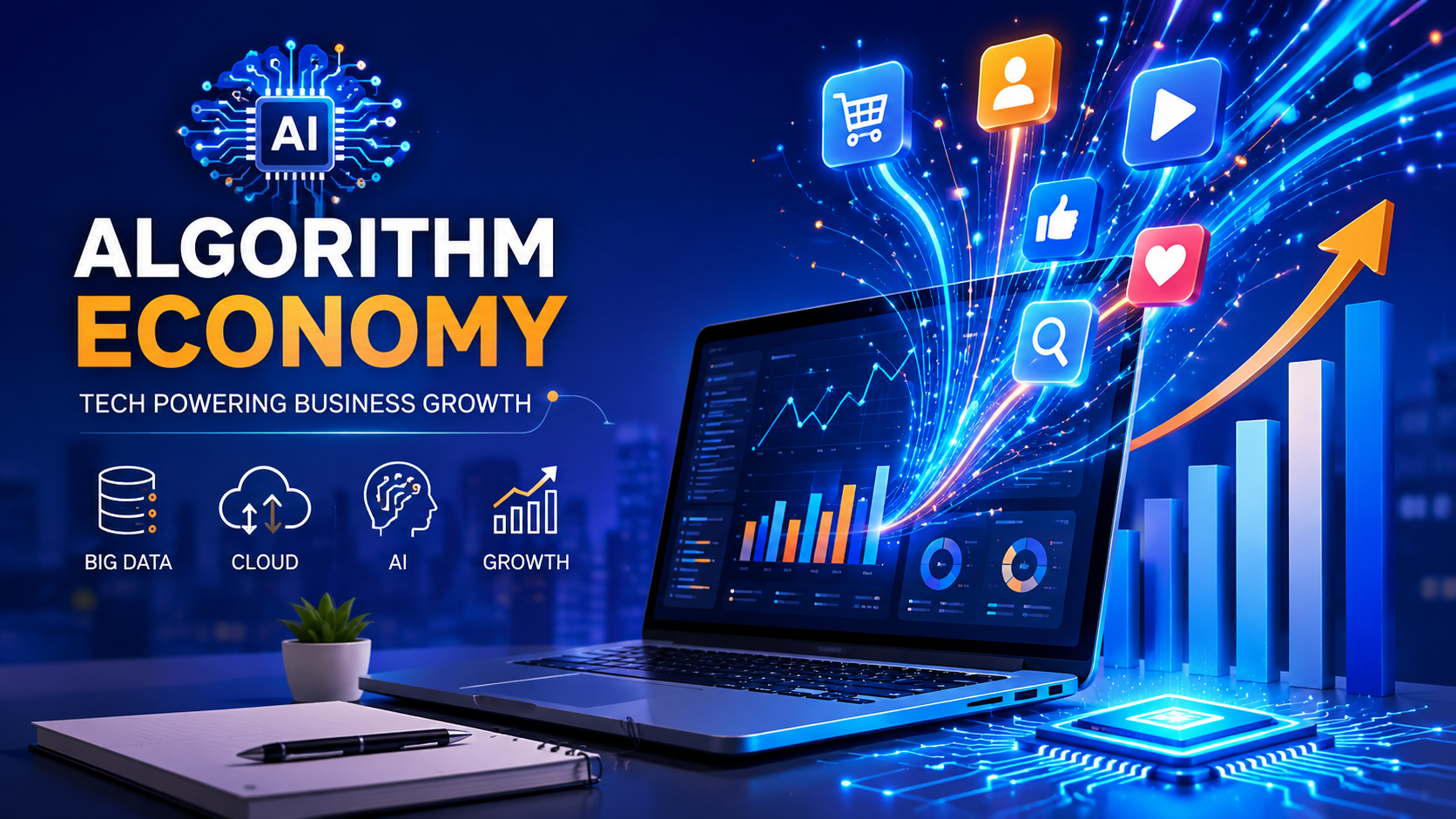
The algorithm economy is the part of the economy in which software rules and AI models make or shape everyday business decisions: which posts appear in your feed, which products you are shown, how prices change, which ads you see, which job applications are shortlisted and which card payments are blocked as fraud. It runs on 3 foundations: large amounts of data, machine learning and cheap cloud computing. Algorithms let companies decide faster and serve millions of customers at once, but they also raise real questions about privacy, fairness, jobs and what happens when automated systems get things wrong. This guide explains how the algorithm economy works, where it is heading under new rules, and how even small businesses can use it responsibly.
Last updated: November 2026.
What Is the Algorithm Economy?
An algorithm is a set of instructions a computer follows to solve a problem or make a decision. In the algorithm economy, these instructions, often trained on data with machine learning, take over decisions that people used to make case by case or that would be impossible at scale. A single recommendation system can personalise the homepage for hundreds of millions of shoppers; no team of humans could do that.
Adoption is now mainstream. McKinsey’s 2025 global survey found that 88% of organisations use AI regularly in at least one business function, up from 78% a year earlier, and 62% are at least experimenting with AI agents. Most, however, are still in pilot stages rather than using AI across the whole business.
Which Types of Algorithms Run Modern Business?
| Algorithm type | What it does | Everyday example |
|---|---|---|
| Recommendation | Predicts what each user is likely to want next | Shows and films suggested by a streaming service; “customers also bought” lists |
| Ranking | Orders results by relevance and quality signals | Search engine results; marketplace product listings |
| Dynamic pricing | Adjusts prices with demand, time and supply | Ride-hailing surge prices; airline and hotel fares |
| Matching | Pairs two sides of a market | Riders with drivers; freelancers with clients |
| Fraud and risk detection | Flags unusual patterns in real time | Card payments blocked for unusual spending |
| Forecasting | Predicts demand, stock needs or cash flow | Retail inventory planning; delivery route planning |
| Ad targeting | Chooses which ad to show to which person | Social media and search advertising |

What Made the Algorithm Economy Possible?
Big Data
Phones, websites, payment systems and connected devices generate a constant stream of data about what people search for, buy and watch. With about 6 billion people online in 2025, according to the International Telecommunication Union, the volume of behavioural data is larger than ever. Algorithms turn that data into predictions.
Machine Learning and AI
Machine learning lets a system learn patterns from past examples instead of following hand-written rules. Generative AI added the ability to write, summarise and answer questions, which brought algorithms into customer service, marketing and office work. Read more in how AI is changing business and jobs in 2026.
Cloud Computing
Companies once needed their own servers to run complex software. Cloud computing lets any business rent computing power and storage by the hour, so a five-person company can use the same kinds of tools as a multinational. Security still depends on how well those systems are configured and managed.
What Are the Benefits for Businesses?
- Faster decisions: algorithms process large data sets in seconds, so prices, stock and offers can respond to demand the same day.
- Personalisation at scale: each customer can see relevant products and content, which usually lifts conversion.
- Lower costs: automating repetitive work such as data entry, routing and first-line support frees staff for higher-value tasks, although systems still need investment and skilled people to run.
- Better risk control: fraud and credit models catch patterns humans would miss.
- New products: data reveals unmet needs and trends earlier. Our guide to data-driven marketing shows how to turn customer insight into revenue.

What Are the Risks of the Algorithm Economy?
Errors at Scale
When a human makes a mistake, it usually affects one case. When an algorithm makes a mistake, it can affect thousands of customers before anyone notices. In McKinsey’s 2025 survey, 51% of respondents said their organisation had experienced at least one negative consequence from AI use, most often inaccurate output.
Bias and Fairness
Algorithms learn from historical data. If that data reflects past unfairness, the system can repeat it, for example by favouring certain applicants in hiring or lending. Regular testing of outcomes across different customer groups is the main safeguard.
Privacy
Personalisation depends on personal data. Businesses must collect only what they need, explain how it is used and follow privacy laws such as the EU’s General Data Protection Regulation (GDPR) and the growing number of US state privacy laws.
Concentrated Power
The companies with the most data can train the best algorithms, which attracts more users and more data. Regulators are paying attention: in September 2025 a US federal judge ordered Google to share some search index and user-interaction data with competitors as a remedy in the government’s search monopoly case, while rejecting a forced sale of Chrome or Android.
Jobs and Skills
Automation reduces demand for some routine tasks while creating demand for people who can build, check and apply algorithms. Training staff to work alongside these tools is usually more valuable than replacing them.
How Are Governments Regulating Algorithms?
The European Union’s AI Act is the most comprehensive law so far. It sorts AI systems by risk level, bans some uses outright and sets strict duties for “high-risk” systems such as those used in hiring, credit scoring and education. Obligations for general-purpose AI models have applied since August 2025. In May 2026, EU lawmakers reached a provisional agreement under the Digital Omnibus to delay most high-risk obligations, moving the date for stand-alone high-risk systems from 2 August 2026 to 2 December 2027. Businesses selling into the EU still need to prepare, because the core requirements have not been removed.
In the United States, rules are spread across existing consumer protection, anti-discrimination and privacy laws, plus state laws on automated decision-making.
How Can Small Businesses Use Algorithms Responsibly?
- Start with one clear problem, such as forecasting stock, answering common customer questions or scoring sales leads.
- Use proven, affordable tools built into your accounting, e-commerce or CRM software before building anything custom.
- Keep a human in the loop for decisions that affect people’s money, jobs or access to services.
- Check results monthly against what actually happened and against different customer groups.
- Collect only the data you need and tell customers how you use it.
- Have a manual fallback in case a system fails or gives strange results.
For larger organisations moving from experiments to company-wide use, see AI in the enterprise: from pilot projects to operational scale, and for how technology becomes the product itself, read From Startup to System.
Frequently Asked Questions
What is the algorithm economy?
It is an economy in which algorithms and AI make or shape many business decisions, including recommendations, pricing, advertising, hiring and fraud detection.
Can small businesses benefit from algorithms?
Yes. Affordable cloud tools for marketing, accounting, inventory and customer service give small firms access to the same kinds of algorithms that large companies use.
Are algorithms always fair?
No. They can repeat bias in the data they learn from, so they need regular testing and human oversight.
When do the EU AI Act’s high-risk rules apply?
Under the provisional Digital Omnibus agreement of May 2026, obligations for stand-alone high-risk systems move to 2 December 2027. Rules for general-purpose AI models have applied since August 2025.